
SettingsSettings for this calculationUS
The total number of underpinning pits in the sequence.
Underpinning is typically done in a 1-in-4 or 1-in-5 alternating sequence to maintain the existing footing's overall stability during construction.
The length of each individual pit.
Commonly limited to about 1-1.2m per pit to limit how much of the existing footing is unsupported at once.
The width of each pit.
Typically matches or slightly exceeds the existing footing width.
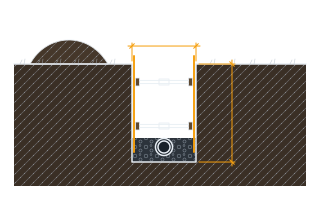
The depth of each pit, down to the new bearing level.
Down to the NEW bearing level, which is below the existing footing rather than level with it — the pit only exists to reach ground that the original foundation did not. The depth therefore has to include the full thickness of the new mass concrete plus the gap left at the top for dry-packing, which is what actually transfers the wall's load onto the new work once it has cured.
Total excavation volume
13 yd³
Doesn't include temporary shoring, dewatering, or the new underpinning concrete volume itself — this is excavation volume only.
- Volume per pit
- 2.59 yd³
They open the calculator with your figures already in it
Underpinning Pit Excavation Volume Calculator: 12.96 yd³ — shown in imperial, US market. The link sets both, so the result they see is the one on your screen.
Show calculation logicHide calculation logic
How this was calculated
Formula source(s)
- Underpinning is typically excavated as a series of individual pits beneath an existing footing; total excavation volume = pit count x pit length x pit width x pit depth
Inputs used
- Number of Pits
- 5
- Pit Length
- 4 ft
- Pit Width
- 3.5 ft
- Pit Depth
- 5 ft
Intermediate steps
- Volume per pit
- 2.59 yd³
Confidence note: Doesn't include temporary shoring, dewatering, or the new underpinning concrete volume itself — this is excavation volume only.
What this calculation does not cover
- This is bank volume — soil measured as it sits in the ground. It bulks once it is on the shovel, so skip fills, grab loads and barrow runs all count a larger figure than this, by an amount that depends on the soil. None of it is backfilled either: the hole is filled with concrete, so the whole volume leaves site.
- The calculation takes the three dimensions exactly as typed and adds nothing to them. There is no allowance for working space, shutter and strut clearance, over-dig, or the toe projections a pin is designed to make beyond the existing footing — enter the footing width as the pit width and the dig comes out short.
- Every pit is treated as the same box repeated. Corners, returns, stepped footings, eccentric pins where projection is permitted one way only, and bays crossed by a live drain or service are all different shapes, and folding them into one average bay misprices the exceptions. Run the standard bay here and carry the odd ones as their own lines.
- This is a quantity take-off, not a design and not a temporary works check. Bay length, how many bays may stand open at once, how far apart they must be, the excavation support, and the depth needed to reach a stratum that will bear are decisions for the engineer who signs the sequence. Nothing here verifies that the dimensions you entered are safe to excavate beneath a loaded footing.
- The figure is neither the concrete order nor the price. The pin is cast short of the existing footing so the dry-pack joint can be rammed, and any blinding sits inside the same depth, so pit volume overstates the mass concrete — and a sequenced underpin is bought in visits per bay (dig, shutter, pour, strike, return to dry-pack, monitor, stand while the neighbouring bay makes strength), which does not scale with volume.
Estimated cost — your price
This site holds no price list for this material — local prices vary too much to publish honestly. Enter your supplier's price and the result is costed with it.
Computed in your browser — nothing you enter is uploaded. Presented in US customary units and US trade terminology. Where a formula follows a published standard, that standard and its edition are cited beside it on this page; where none governs, the page says so. Local amendments override model codes — verify against the code in force where you build.
Sources checked 2026-09-02 · in the site-wide review of 2026-09-06 · v1.0.1
Regulatory standards & verification citations1
- Underpinning is typically excavated as a series of individual pits beneath an existing footing; total excavation volume = pit count x pit length x pit width x pit depth
Cite this page
Your workspace
Most jobs need more than one number. Add the calculators you need next and they open right here, underneath this one — your figures stay on screen and nothing is lost to a page change.