
SettingsSettings for this calculationUS
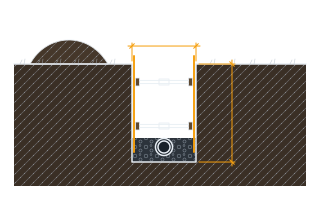
The pit's internal length at the level of the test.
A pit long and narrow rather than square gives more wetted side for the same volume of water and behaves more like the finished soakaway.
The pit's internal width.
Measured on the sides as dug, not the bucket width; an over-dig widens the pit and the wetted area with it.
The depth of water the pit is filled to, from its base to the marked fill level.
The 75% and 25% marks are set from this depth. The pit is dug to the level the soakaway's base will sit at, because the horizon the water will meet is the one to test.
The minutes the level took to fall from the 75% mark to the 25% mark on the first fill.
The Digest asks for three fills, ideally on the same or consecutive days, because the first is influenced by how dry the ground was; the slowest — the longest time — is the one the design runs on.
The minutes the level took to fall from the 75% mark to the 25% mark on the second fill.
The Digest asks for three fills, ideally on the same or consecutive days, because the first is influenced by how dry the ground was; the slowest — the longest time — is the one the design runs on.
The minutes the level took to fall from the 75% mark to the 25% mark on the third fill.
The Digest asks for three fills, ideally on the same or consecutive days, because the first is influenced by how dry the ground was; the slowest — the longest time — is the one the design runs on.
Soil infiltration rate f (slowest fill)
0.44 in/h
BRE Digest 365 states the same rate in metres per second, the figure the storage and half-emptying sums take. The design runs on the slowest of the three fills, the one closest to the ground's wet-season condition.
- Water lost between the 75% and 25% marks
- 0.49 yd³
- Wetted area to half depth, base included
- 30.25 ft²
- Slowest fill, 75% to 25%
- 710 min
- Rate from fill 1
- 0.54 in/h
- Rate from fill 2
- 0.47 in/h
- Rate from fill 3
- 0.44 in/h
They open the calculator with your figures already in it
Soakaway Infiltration Rate Calculator (BRE 365 Trial Pit): 0.44 in/h — shown in imperial, US market. The link sets both, so the result they see is the one on your screen.
Show calculation logicHide calculation logic
How this was calculated
Formula source(s)
- BRE Digest 365 Soakaway design: the soil infiltration rate f = Vp75–25 ÷ (ap50 × tp75–25), where Vp75–25 is the volume of water in the pit between 75% and 25% of the effective depth, ap50 the internal surface area of the pit up to 50% of the effective depth including the base, and tp75–25 the time for the level to fall from 75% to 25%; the pit is filled three times and the lowest rate is used
Inputs used
- Trial Pit Length
- 5 ft
- Trial Pit Width
- 1.5 ft
- Effective Depth of Water
- 3.5 ft
- Fill 1: Time from 75% to 25% Depth (minutes)
- 580
- Fill 2: Time from 75% to 25% Depth (minutes, 0 if not run)
- 660
- Fill 3: Time from 75% to 25% Depth (minutes, 0 if not run)
- 710
Intermediate steps
- Water lost between the 75% and 25% marks
- 0.49 yd³
- Wetted area to half depth, base included
- 30.25 ft²
- Slowest fill, 75% to 25%
- 710 min
- Rate from fill 1
- 0.54 in/h
- Rate from fill 2
- 0.47 in/h
- Rate from fill 3
- 0.44 in/h
Confidence note: BRE Digest 365 states the same rate in metres per second, the figure the storage and half-emptying sums take. The design runs on the slowest of the three fills, the one closest to the ground's wet-season condition.
What this calculation does not cover
- The trial pit's area is taken to half depth INCLUDING its base; the soakaway's own area in the storage sum is the sides only, because a soakaway's base silts up. Using the pit's figure for the finished soakaway overstates what it will drain.
- It measures the horizon the pit was dug in. A pit that stops in topsoil above a clay, or a rate measured in the first spit, says nothing about the ground the soakaway will actually sit in.
- A rate from one location on one day. Ground varies across a site and through the year, a rising water table stops a soakaway working, and building control may ask for a test in the wetter months.
Add the equipment this sizes
This result is a specification — 0.44 in/h — not a quantity. Put the thing it sizes into your project: how many, what you call it, and your supplier’s price.
Computed in your browser — nothing you enter is uploaded. Presented in US customary units and US trade terminology. Where a formula follows a published standard, that standard and its edition are cited beside it on this page; where none governs, the page says so. Local amendments override model codes — verify against the code in force where you build.
Sources checked 2026-09-22 · v1.0.0
Regulatory standards & verification citations1
- BRE Digest 365 Soakaway design: the soil infiltration rate f = Vp75–25 ÷ (ap50 × tp75–25), where Vp75–25 is the volume of water in the pit between 75% and 25% of the effective depth, ap50 the internal surface area of the pit up to 50% of the effective depth including the base, and tp75–25 the time for the level to fall from 75% to 25%; the pit is filled three times and the lowest rate is used
Cite this page
Your workspace
Most jobs need more than one number. Add the calculators you need next and they open right here, underneath this one — your figures stay on screen and nothing is lost to a page change.