
SettingsSettings for this calculationUS
The plan area of roof and paving that drains to this soakaway.
Plan area, not the sloping surface: rain falls vertically, so a pitched roof collects its footprint. Every downpipe and gully that reaches the soakaway counts.
The slowest rate from the trial pit, from the soakaway infiltration rate calculator.
The Digest writes it in metres per second: multiply a m/s figure by 3,600,000 for mm/h. 3.2 × 10⁻⁶ m/s is 11.52 mm/h, or 0.45 in/h.
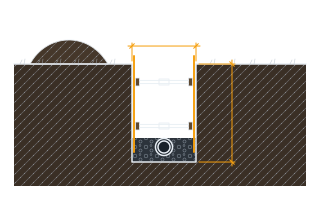
The internal length of the store — the crate run or the stone-filled trench.
A long narrow soakaway has more side area for the same volume, which is what empties it; see the note on plan area over perimeter.
The internal width of the store.
One crate module wide is often the shape that empties in time on slow ground, where a compact box of the same volume does not.
The depth of the store below the inlet, which is the depth that can hold water.
Measured from the base to the invert of the incoming pipe; anything above the inlet is not storage.
About 0.95 for geocellular crates and about 0.30 for clean single-size stone.
The share of the store that is space for water. Take it from the crate maker's datasheet or the aggregate supplier's test data rather than a rule of thumb.
A storm duration to test, in minutes.
The Digest runs durations from a few minutes to a day or two, because inflow rises quickly and flattens while outflow grows steadily; the worst one is found, not chosen.
The rainfall depth for that duration at the design return period, from your site's rainfall data.
From the Flood Estimation Handbook in current UK practice, the Digest's own tables built on the Flood Studies Report, or NOAA Atlas 14 in the United States, with the return period and any climate-change uplift the approving authority requires. The defaults are the guide's placeholders, not data for any site.
A storm duration to test, in minutes.
The Digest runs durations from a few minutes to a day or two, because inflow rises quickly and flattens while outflow grows steadily; the worst one is found, not chosen.
The rainfall depth for that duration at the design return period, from your site's rainfall data.
From the Flood Estimation Handbook in current UK practice, the Digest's own tables built on the Flood Studies Report, or NOAA Atlas 14 in the United States, with the return period and any climate-change uplift the approving authority requires. The defaults are the guide's placeholders, not data for any site.
A storm duration to test, in minutes.
The Digest runs durations from a few minutes to a day or two, because inflow rises quickly and flattens while outflow grows steadily; the worst one is found, not chosen.
The rainfall depth for that duration at the design return period, from your site's rainfall data.
From the Flood Estimation Handbook in current UK practice, the Digest's own tables built on the Flood Studies Report, or NOAA Atlas 14 in the United States, with the return period and any climate-change uplift the approving authority requires. The defaults are the guide's placeholders, not data for any site.
A storm duration to test, in minutes.
The Digest runs durations from a few minutes to a day or two, because inflow rises quickly and flattens while outflow grows steadily; the worst one is found, not chosen.
The rainfall depth for that duration at the design return period, from your site's rainfall data.
From the Flood Estimation Handbook in current UK practice, the Digest's own tables built on the Flood Studies Report, or NOAA Atlas 14 in the United States, with the return period and any climate-change uplift the approving authority requires. The defaults are the guide's placeholders, not data for any site.
A storm duration to test, in minutes.
The Digest runs durations from a few minutes to a day or two, because inflow rises quickly and flattens while outflow grows steadily; the worst one is found, not chosen.
The rainfall depth for that duration at the design return period, from your site's rainfall data.
From the Flood Estimation Handbook in current UK practice, the Digest's own tables built on the Flood Studies Report, or NOAA Atlas 14 in the United States, with the return period and any climate-change uplift the approving authority requires. The defaults are the guide's placeholders, not data for any site.
A storm duration to test, in minutes.
The Digest runs durations from a few minutes to a day or two, because inflow rises quickly and flattens while outflow grows steadily; the worst one is found, not chosen.
The rainfall depth for that duration at the design return period, from your site's rainfall data.
From the Flood Estimation Handbook in current UK practice, the Digest's own tables built on the Flood Studies Report, or NOAA Atlas 14 in the United States, with the return period and any climate-change uplift the approving authority requires. The defaults are the guide's placeholders, not data for any site.
A storm duration to test, in minutes.
The Digest runs durations from a few minutes to a day or two, because inflow rises quickly and flattens while outflow grows steadily; the worst one is found, not chosen.
The rainfall depth for that duration at the design return period, from your site's rainfall data.
From the Flood Estimation Handbook in current UK practice, the Digest's own tables built on the Flood Studies Report, or NOAA Atlas 14 in the United States, with the return period and any climate-change uplift the approving authority requires. The defaults are the guide's placeholders, not data for any site.
A storm duration to test, in minutes.
The Digest runs durations from a few minutes to a day or two, because inflow rises quickly and flattens while outflow grows steadily; the worst one is found, not chosen.
The rainfall depth for that duration at the design return period, from your site's rainfall data.
From the Flood Estimation Handbook in current UK practice, the Digest's own tables built on the Flood Studies Report, or NOAA Atlas 14 in the United States, with the return period and any climate-change uplift the approving authority requires. The defaults are the guide's placeholders, not data for any site.
Storage required at the critical storm
1.91 yd³
The store as drawn holds more than the critical storm leaves behind. It empties to half within the 24 hours BRE Digest 365 asks for.
- Storage the store provides
- 2.74 yd³
- Critical storm duration
- 1,440 min
- Inflow over the critical storm
- 3.86 yd³
- Outflow over the critical storm
- 1.95 yd³
- Side area to half depth (base excluded)
- 58 ft²
- Time to empty to half
- 16.9 hours
- Time the Digest asks for, at most
- 24 hours
- Plan area ÷ perimeter
- 0.67 ft
- Largest plan area ÷ perimeter that half-empties in 24 hours
- 0.95 ft
They open the calculator with your figures already in it
Soakaway Storage and Half-Emptying Time Calculator (BRE 365): 1.91 yd³ — shown in imperial, US market. The link sets both, so the result they see is the one on your screen.
Show calculation logicHide calculation logic
How this was calculated
Formula source(s)
- BRE Digest 365 Soakaway design: inflow I = impermeable area × rainfall depth for each storm duration D; outflow O = as50 × f × D, where as50 is the internal surface area of the soakaway to 50% of its effective storage depth, excluding the base; the storage required is the largest I − O over the durations tested; the time to half empty ts50 = 0.5 × storage volume ÷ (as50 × f), usually required within 24 hours
Inputs used
- Impermeable Area Drained to the Soakaway
- 500 sq ft
- Soil Infiltration Rate f
- 0.45 in/h
- Soakaway Length
- 13 ft
- Soakaway Width
- 1.5 ft
- Effective Storage Depth
- 4 ft
- Free Volume of the Fill (void ratio)
- 0.95
- Storm 1 Duration (minutes, 0 if unused)
- 15
- Storm 1 Rainfall Depth
- 0.5 in
- Storm 2 Duration (minutes, 0 if unused)
- 60
- Storm 2 Rainfall Depth
- 0.87 in
- Storm 3 Duration (minutes, 0 if unused)
- 360
- Storm 3 Rainfall Depth
- 1.5 in
- Storm 4 Duration (minutes, 0 if unused)
- 1440
- Storm 4 Rainfall Depth
- 2.5 in
- Storm 5 Duration (minutes, 0 if unused)
- 2880
- Storm 5 Rainfall Depth
- 3.25 in
- Storm 6 Duration (minutes, 0 if unused)
- 0
- Storm 6 Rainfall Depth
- 0 in
- Storm 7 Duration (minutes, 0 if unused)
- 0
- Storm 7 Rainfall Depth
- 0 in
- Storm 8 Duration (minutes, 0 if unused)
- 0
- Storm 8 Rainfall Depth
- 0 in
Intermediate steps
- Storage the store provides
- 2.74 yd³
- Critical storm duration
- 1,440 min
- Inflow over the critical storm
- 3.86 yd³
- Outflow over the critical storm
- 1.95 yd³
- Side area to half depth (base excluded)
- 58 ft²
- Time to empty to half
- 16.9 hours
- Time the Digest asks for, at most
- 24 hours
- Plan area ÷ perimeter
- 0.67 ft
- Largest plan area ÷ perimeter that half-empties in 24 hours
- 0.95 ft
Confidence note: The store as drawn holds more than the critical storm leaves behind. It empties to half within the 24 hours BRE Digest 365 asks for.
What this calculation does not cover
- The rainfall depths belong to the site and to the approving authority's design standard — return period, climate-change allowance — and none of the defaults on this page is data for any location.
- The store is taken as a rectangle with vertical sides, emptying through its sides only; the base is written off because it silts up. A soakaway ring, a sloping-sided pit or a store with a sealed side needs its own side area.
- The half-emptying time is worked on the storage the store provides, full to its effective depth. A store that is only part-filled by the design storm empties the same fraction in the same time, because the side area and the stored volume fall together.
- A soakaway is an infiltration device, and it is only the right answer where the ground takes water, the water table stays below it, and it is far enough from buildings and boundaries; building control and the Building Regulations' drainage guidance settle those before the arithmetic starts.
Estimated cost — your price
This site holds no price list for this material — local prices vary too much to publish honestly. Enter your supplier's price and the result is costed with it.
Computed in your browser — nothing you enter is uploaded. Presented in US customary units and US trade terminology. Where a formula follows a published standard, that standard and its edition are cited beside it on this page; where none governs, the page says so. Local amendments override model codes — verify against the code in force where you build.
Sources checked 2026-09-22 · v1.0.0
Regulatory standards & verification citations1
- BRE Digest 365 Soakaway design: inflow I = impermeable area × rainfall depth for each storm duration D; outflow O = as50 × f × D, where as50 is the internal surface area of the soakaway to 50% of its effective storage depth, excluding the base; the storage required is the largest I − O over the durations tested; the time to half empty ts50 = 0.5 × storage volume ÷ (as50 × f), usually required within 24 hours
Cite this page
Your workspace
Most jobs need more than one number. Add the calculators you need next and they open right here, underneath this one — your figures stay on screen and nothing is lost to a page change.