
SettingsSettings for this calculationUS
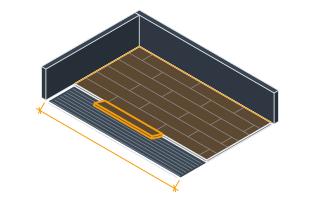
The total floor area to be poured with epoxy terrazzo.
Measure the room's length x width, or add up multiple sections for an irregular floor plan.
The thickness of the terrazzo topping pour.
Epoxy terrazzo toppings are typically much thinner than traditional cement terrazzo, commonly 6-10mm.
The density of the fully blended resin-and-aggregate mix.
Check your specific terrazzo system's technical data sheet for its blended mix density — it varies with the aggregate type and gradation used.
How many parts of aggregate are used per one part of resin, by weight.
Commonly specified in the range of 1:3.5 to 1:4 (resin:aggregate) — confirm your specific manufacturer's system ratio.
Aggregate mass needed
694 lb
Exact resin:aggregate ratios vary by manufacturer system and desired aggregate exposure — confirm your terrazzo system's specified ratio before ordering material.
- Resin needed
- 198.38 lb
- Total mix mass
- 892.72 lb
They open the calculator with your figures already in it
Epoxy Terrazzo Resin-to-Aggregate Mix Calculator: 694 lb — shown in imperial, US market. The link sets both, so the result they see is the one on your screen.
Show calculation logicHide calculation logic
How this was calculated
Formula source(s)
- Epoxy terrazzo mixes are typically specified by a resin:aggregate ratio by weight (commonly around 1:3.5 to 1:4); total mix mass = pour volume × blended mix density, split proportionally by the ratio
Inputs used
- Pour Area
- 220 sq ft
- Pour Thickness
- 0.39 in
- Blended Mix Density
- 124.86 pcf
- Aggregate-to-Resin Ratio (parts aggregate per 1 part resin, by weight)
- 3.5
Intermediate steps
- Resin needed
- 198.38 lb
- Total mix mass
- 892.72 lb
Confidence note: Exact resin:aggregate ratios vary by manufacturer system and desired aggregate exposure — confirm your terrazzo system's specified ratio before ordering material.
What this calculation does not cover
- Multiplies a nominal thickness by an area, and neither the slab nor the finish is that tidy. Terrazzo fills every low spot in the floor it is placed over and is then ground back, so the material genuinely consumed is the nominal thickness plus what the substrate's flatness swallows plus the grind allowance. Order to the nominal figure over an unprepared, out-of-tolerance slab and the last section comes up short.
- Resin is given as a mass, and epoxy is bought as kits with a fixed part A to part B ratio and a pot life measured in minutes. A kit cannot be part-mixed to hit a number, and anything mixed but not spread inside the pot life is scrap — so the order is whole kits rounded up, with batch size matched to how fast the crew can place it.
Estimated cost — your price
This site holds no price list for this material — local prices vary too much to publish honestly. Enter your supplier's price and the result is costed with it.
Computed in your browser — nothing you enter is uploaded. Presented in US customary units and US trade terminology. Where a formula follows a published standard, that standard and its edition are cited beside it on this page; where none governs, the page says so. Local amendments override model codes — verify against the code in force where you build.
Sources checked 2026-09-06 · in the site-wide review of 2026-09-06 · v1.1.1
Regulatory standards & verification citations1
- Epoxy terrazzo mixes are typically specified by a resin:aggregate ratio by weight (commonly around 1:3.5 to 1:4); total mix mass = pour volume × blended mix density, split proportionally by the ratio
Cite this page
Your workspace
Most jobs need more than one number. Add the calculators you need next and they open right here, underneath this one — your figures stay on screen and nothing is lost to a page change.