
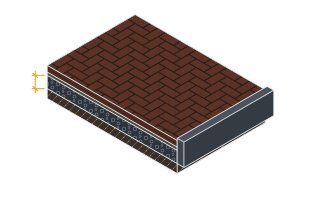
SettingsSettings for this calculationUS
The plan area of permeable surfacing being laid.
Use the area of permeable units only. Solid edge courses, kerb lines and any conventional paving inside the same layout carry no jointing stone and should be left out, since including them inflates a quantity that is already easy to over-order.
The proportion of the surface made up of joints and apertures.
Take this from the paver manufacturer's data, because it varies widely between a narrow-jointed interlocking unit and a large-aperture grid, and it varies again with the laying pattern. It is the single input that most moves the answer.
How deep the stone sits in the joint or aperture.
Usually the full depth of the unit, since the joint stone runs down to meet the bedding course. Where the aperture is tapered or partly closed at the base, the effective depth is less than the unit is thick and the quantity falls with it.
The delivered bulk density of the jointing aggregate.
Small single-sized angular stone is bulky and light for its volume, and the figure moves with the gradation, the parent rock and how wet the load is. Get it from the supplier for the material actually being delivered rather than accepting a generic value.
Extra stone the joints take as the pavement is vibrated and refilled.
Joints are filled, compacted, and filled again — often more than once — because vibration settles the stone and opens the joint back up. A rule of thumb rather than a published figure, and worth revising upward on units with wide apertures.
Proportion of the joint volume replaced at each cleaning cycle.
Vacuum sweeping to restore infiltration removes the clogged upper part of the joint along with the silt, and that stone has to be put back. How much depends on the sediment load reaching the surface and on how aggressive the cleaning regime is.
Jointing stone for the first fill
1,940 lb
Joint fill is the working part of a permeable pavement — it is where the water goes in, and a pavement whose joints have not been kept topped up stops infiltrating long before anything else in the build-up fails. Order the first fill with the pavers, and put the replenishment quantity into the maintenance plan rather than discovering it later.
- Loose stone volume in the joints
- 0.67 yd³
- Stone before the compaction allowance
- 1,685.55 lb
- Stone for each replenishment round
- 84.28 lb
- First fill plus one replenishment round
- 2,022.67 lb
They open the calculator with your figures already in it
Permeable Pavement Joint Fill Stone Calculator: 1,938 lb — shown in imperial, US market. The link sets both, so the result they see is the one on your screen.
Show calculation logicHide calculation logic
How this was calculated
Formula source(s)
- ASCE/T&DI 68-18, Permeable Interlocking Concrete Pavement, which covers the construction and the maintenance regime that makes joint replenishment a recurring quantity rather than a one-off
- ASTM D448 defines the standard size numbers used for jointing and bedding aggregate in permeable pavements; the gradation chosen changes both the void structure and the bulk density entered here
- The top-up and replenishment percentages are rules of thumb, not published figures — the joints take more stone during compaction than their nominal volume, and lose some at every cleaning cycle, by amounts that depend on the unit, the plant and the site
Inputs used
- Laid Pavement Area
- 1080 sq ft
- Open Area of the Units
- 10
- Depth of Joint Fill
- 2 in
- Loose Bulk Density of the Stone
- 93.64 pcf
- Compaction Top-Up Allowance
- 15
- Replenishment per Maintenance Round
- 5
Intermediate steps
- Loose stone volume in the joints
- 0.67 yd³
- Stone before the compaction allowance
- 1,685.55 lb
- Stone for each replenishment round
- 84.28 lb
- First fill plus one replenishment round
- 2,022.67 lb
Confidence note: Joint fill is the working part of a permeable pavement — it is where the water goes in, and a pavement whose joints have not been kept topped up stops infiltrating long before anything else in the build-up fails. Order the first fill with the pavers, and put the replenishment quantity into the maintenance plan rather than discovering it later.
What this calculation does not cover
- Jointing and aperture stone only. The bedding course, the open-graded base and subbase, geotextiles and edge restraints are separate quantities on their own gradations.
- Does not size the pavement hydraulically. Whether the joints and the reservoir beneath them accept the design storm is an infiltration and storage calculation.
Estimated cost — your price
This site holds no price list for this material — local prices vary too much to publish honestly. Enter your supplier's price and the result is costed with it.
Computed in your browser — nothing you enter is uploaded. Presented in US customary units and US trade terminology. Where a formula follows a published standard, that standard and its edition are cited beside it on this page; where none governs, the page says so. Local amendments override model codes — verify against the code in force where you build.
Sources checked 2026-08-30 · in the site-wide review of 2026-09-06 · v1.0.0
Regulatory standards & verification citations3
- ASCE/T&DI 68-18, Permeable Interlocking Concrete Pavement, which covers the construction and the maintenance regime that makes joint replenishment a recurring quantity rather than a one-off
- ASTM D448 defines the standard size numbers used for jointing and bedding aggregate in permeable pavements; the gradation chosen changes both the void structure and the bulk density entered here
- The top-up and replenishment percentages are rules of thumb, not published figures — the joints take more stone during compaction than their nominal volume, and lose some at every cleaning cycle, by amounts that depend on the unit, the plant and the site
Which documents these citations point at
Standards referenced: ASTM D448 (ASTM International, United States).
Cite this page
Your workspace
Most jobs need more than one number. Add the calculators you need next and they open right here, underneath this one — your figures stay on screen and nothing is lost to a page change.