
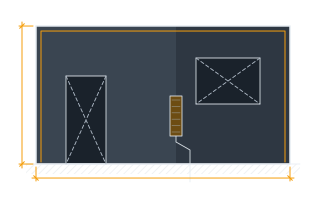
SettingsSettings for this calculationUS
The full outside perimeter of the member's cross-section.
Measure (or sum from the shape's dimensions) the total outside perimeter that will actually be coated — for example, an I-beam's perimeter wraps both flanges and the web on each side.
The length of each individual member.
One member's length, with the count entered separately — they are separate fields because primer coverage depends on surface area and a hundred short members have far more end area and far more handling loss than one long one. Use the cut length rather than the stock length.
How many identical members are being coated.
How many pieces of that length. Where members differ, run the calculation per size rather than averaging: coverage is area-driven, and an average length across mixed sizes gets the area wrong in the direction of the biggest count. Add an allowance for touching up after erection — a member primed in the shop is scraped on the way up.
The coating's rated spreading rate, from its technical data sheet.
Use the manufacturer's rated theoretical or practical coverage rate for the specific primer or paint product and application method (spray, brush, roller).
Primer/paint needed
1.42 gal
Coverage rate varies significantly by product (primer vs. topcoat, surface profile) — confirm your specific coating's rated coverage from its technical data sheet.
- Total surface area
- 568.75 sq ft
They open the calculator with your figures already in it
Structural Steel Primer Coverage Calculator: 1.42 gal — shown in imperial, US market. The link sets both, so the result they see is the one on your screen.
Show calculation logicHide calculation logic
How this was calculated
Formula source(s)
- Steel surface area = member perimeter × length × count; paint/primer volume = surface area ÷ manufacturer coverage rate
Inputs used
- Member Cross-Section Perimeter
- 35 in
- Member Length
- 19.5 ft
- Number of Members
- 10
- Coverage Rate
- 400 ft²/gal
Intermediate steps
- Total surface area
- 568.75 sq ft
Confidence note: Coverage rate varies significantly by product (primer vs. topcoat, surface profile) — confirm your specific coating's rated coverage from its technical data sheet.
What this calculation does not cover
- A coverage rate is quoted at a stated dry film thickness, and the specification usually sets a different one. Coverage scales inversely with DFT: a product rated at 50 microns (2 mils) delivers two fifths as much area at 125 microns (5 mils), so entering the data sheet's headline figure against a thicker specified film understates the paint by the ratio between them. Take the rate and its DFT together, and check whether it is the theoretical figure or one already discounted for loss.
- Nothing comes off for what never reaches the steel. Spraying open framework is inefficient in a way painting a wall is not — a large part of the fan passes between the flanges and the web and lands on the floor — and more stays in the pot, the hose and the tin. Blast-cleaned steel takes its share as well: a 50 to 75 micron surface profile has to be filled before any film builds over it, and the first coat pays for that.
- Perimeter × length × count describes plain, straight, identical members. The gussets, cleats, end plates, stiffeners and base plates welded to them are extra area carrying far more edge per square metre than the members do, while the areas deliberately left bare — faying surfaces in slip-critical joints, weld preparations, and anything to receive sprayed fire protection — come back off. On a connection-heavy frame those two corrections do not cancel.
Estimated cost — your price
This site holds no price list for this material — local prices vary too much to publish honestly. Enter your supplier's price and the result is costed with it.
Computed in your browser — nothing you enter is uploaded. Presented in US customary units and US trade terminology. Where a formula follows a published standard, that standard and its edition are cited beside it on this page; where none governs, the page says so. Local amendments override model codes — verify against the code in force where you build.
Sources checked 2026-09-06 · in the site-wide review of 2026-09-06 · v1.1.1
Regulatory standards & verification citations1
- Steel surface area = member perimeter × length × count; paint/primer volume = surface area ÷ manufacturer coverage rate
Cite this page
Your workspace
Most jobs need more than one number. Add the calculators you need next and they open right here, underneath this one — your figures stay on screen and nothing is lost to a page change.
Protection this work requires
- Stop and check first. Paint under later coats in older housing can be lead-based, and sanding or heat-stripping it produces lead dust that is especially harmful to children and to anyone pregnant. Test before you disturb it — this is a job for a tested, controlled method, not a better mask.
Tools and safety for this job
To roll and cut in two coats and prepare a surface for paint. Generic types, no brands, no prices.
- Joint-compound dust is very fine and travels: a P1/FFP1 mask is the minimum, and a damp-sponge finish avoids most of it.
- A dust mask does nothing about solvent vapour: ventilate through, and use an organic-vapour (A1) cartridge respirator in an enclosed room.
- Most fatal falls on small jobs are from under three metres: use a tower or a ladder tied at the top, and never work off the top two rungs.
Show the 11 tools this job needsHide tools
Essential
Brushes
Dust sheets and masking
Filling knife
Roller frame, sleeves and tray
Scraper
Recommended
Caulking gun
Extension pole
Pole sander
Random orbital sander
Step ladder
Optional
Dust extractor or vacuum with a fine filter
Also needed as materials: abrasive discs, caulk and sealant cartridges, masking tape, plastic sheeting, roller sleeves, sanding screens or paper.
what each painting tool is for, and the spec that decides which to buy where one does.