
SettingsSettings for this calculationUS
The width of the chimney or obstruction as measured facing up the roof slope.
This is the dimension the cricket's ridge must span across to divert water around both sides of the obstruction.
The pitch of the main roof the cricket ties into.
A symmetric cricket typically matches the main roof's pitch on each of its two sloped faces.
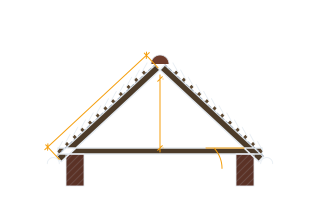
Cricket ridge height
1 ft
They open the calculator with your figures already in it
Roof Cricket (Saddle) Framing Calculator: 1 ft — shown in imperial, US market. The link sets both, so the result they see is the one on your screen.
Show calculation logicHide calculation logic
How this was calculated
Formula source(s)
- A symmetric roof cricket's ridge height = half the obstruction's up-slope-facing width x the main roof's pitch ratio
Inputs used
- Obstruction Width (Facing Up-Slope)
- 4 ft
- Main Roof Pitch (rise per 12)
- 6
What this calculation does not cover
- Does not tell you whether a cricket is required. Codes generally call for a cricket or saddle behind any chimney more than about 760 mm (30 in) wide measured across the slope, and the trigger is that width — not the chimney's height above the roof, and not the roofing material. Below it, back flashing alone is normally the detail.
- Water leaves down the valleys, and a valley always falls at a shallower angle than the two planes that form it. On a low-slope main roof, a cricket built at the main pitch produces valleys whose fall can drop below the minimum slope the covering is listed for, which is how a correctly framed cricket ends up holding a puddle and a line of debris along each side.
Computed in your browser — nothing you enter is uploaded. Presented in US customary units and US trade terminology. Where a formula follows a published standard, that standard and its edition are cited beside it on this page; where none governs, the page says so. Local amendments override model codes — verify against the code in force where you build.
Sources checked 2026-09-06 · in the site-wide review of 2026-09-06 · v1.0.1
Regulatory standards & verification citations1
- A symmetric roof cricket's ridge height = half the obstruction's up-slope-facing width x the main roof's pitch ratio
Cite this page
Your workspace
Most jobs need more than one number. Add the calculators you need next and they open right here, underneath this one — your figures stay on screen and nothing is lost to a page change.
Tools and safety for this job
To frame a stud wall and cut framing lumber. Generic types, no brands, no prices.
Protection this work requires
- Hardwood dust is a recognised carcinogen: extract at the tool and wear a P2/N95 respirator when cutting or sanding indoors.
- Saws, grinders and breakers run above 85 dB, where hearing damage accumulates and does not recover: defenders or plugs for every cut, not just the long ones.
- Nailing, chiselling and cutting all throw fragments: glasses to EN 166 or ANSI Z87.1, and goggles rather than glasses overhead.
Show the 9 tools this job needsHide tools
Essential
Circular saw
Claw hammer
Combination or framing square
Spirit level
Tape measure
Recommended
Chalk line
Framing nailer
Mitre saw
Optional
Hand saw
Also needed as materials: chalk refill, circular saw blades, framing nails, fuel cells, mitre saw blades.
what each carpentry tool is for, and the spec that decides which to buy where one does.