
SettingsSettings for this calculationUS
The compressive axial load the post transfers into the beam below it.
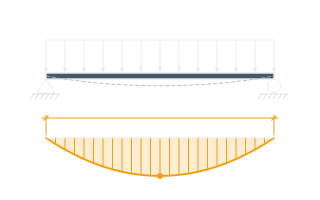
The load arriving at the BOTTOM of the post, which includes the post's own weight and anything landing on it part-way down. Perpendicular-to-grain bearing is usually what governs a timber connection long before the post's own compression does, so this number decides whether a bearing plate is needed — and a post that bears on an unsupported span of beam rather than over a support is a different problem again.
The species/grade's allowable compression stress perpendicular to grain, from the NDS design values.
NDS Fc-perp runs about 2.9-4.3 MPa (425-625 psi) for common softwood species.
Required bearing area
20.67 in²
They open the calculator with your figures already in it
Timber Post Bearing Area Calculator: 20.67 in² — shown in imperial, US market. The link sets both, so the result they see is the one on your screen.
Show calculation logicHide calculation logic
How this was calculated
Formula source(s)
- Required bearing area = axial load ÷ allowable compression stress perpendicular to grain (Fc-perp), the standard NDS timber bearing check
Inputs used
- Axial Load
- 8.99 kip
- Allowable Bearing Stress Fc-perp
- 435.11 psi
What this calculation does not cover
- The Fc-perp figure is used exactly as typed and no NDS adjustment factors are applied to it. The bearing area factor Cb, which raises the allowable value in the form (bearing length + 9.5 mm) divided by bearing length for bearings under about 150 mm long set back at least about 75 mm from the end of the member, is not credited, and the wet service and temperature reductions are not taken off either. Enter a value already adjusted for the edition and service conditions you are designing to.
- Tabulated Fc-perp is governed by a deformation limit of roughly 1 mm (0.04 in) of indentation in the standard test, not by fibre rupture. Meeting the required area therefore controls how far the joint beds down, and exceeding it produces progressive crushing and a settling floor rather than a sudden collapse. Creep is not modelled at all, and perpendicular-to-grain deformation under sustained load keeps growing well beyond the initial value.
- The output is a single area, not a bearing length, a plate size or a post section, and it assumes that whole area is loaded uniformly. Area cannot be won by spreading past the edge of the supporting member, and a thin plate that cantilevers beyond the post face does not deliver uniform stress unless it is stiff enough in bending, which is a separate check. An out-of-plumb, cupped or partially seated bearing contacts over only part of the face and sees a peak stress well above load divided by area.
- Only crushing of the supporting member at one interface is checked. The post's own capacity in compression parallel to grain with the column stability factor CP, the supporting beam's bending and shear under the concentrated load, uplift and lateral restraint at the connection, and the same bearing check repeated at every interface further down the load path are all outside what this page computes.
- Fc-perp from the NDS supplement is an allowable stress, so the axial load entered must be an unfactored service load combination; putting a factored LRFD load such as 1.2D + 1.6L (0.42 gal) against it oversizes the bearing by roughly the load factor. Fc-perp is also one of the few timber design values the load duration factor does not adjust, so a short-duration wind or seismic case does not justify a higher allowable stress here.
Add the equipment this sizes
This result is a specification — 20.67 in² — not a quantity. Put the thing it sizes into your project: how many, what you call it, and your supplier’s price.
Computed in your browser — nothing you enter is uploaded. Presented in US customary units and US trade terminology. Where a formula follows a published standard, that standard and its edition are cited beside it on this page; where none governs, the page says so. Local amendments override model codes — verify against the code in force where you build.
Sources checked 2026-09-02 · in the site-wide review of 2026-09-06 · v1.0.1
Regulatory standards & verification citations1
- Required bearing area = axial load ÷ allowable compression stress perpendicular to grain (Fc-perp), the standard NDS timber bearing check
Cite this page
Your workspace
Most jobs need more than one number. Add the calculators you need next and they open right here, underneath this one — your figures stay on screen and nothing is lost to a page change.