
SettingsSettings for this calculationUS
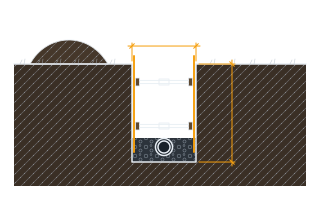
The total required depth of the manhole structure.
Measure from the base slab or barrel section to the finished grade elevation.
The height of the standard precast riser ring being stacked.
Precast riser rings come in standard heights — 6, 8 and 12 in, or 150, 200 and 300 mm — and the one you enter should be the product actually being stacked rather than a nominal figure, because the count is depth divided by this and nothing rounds it for you.
Riser rings needed
10 rings
They open the calculator with your figures already in it
Manhole Ring/Riser Segment Calculator: 10 rings — shown in imperial, US market. The link sets both, so the result they see is the one on your screen.
Show calculation logicHide calculation logic
How this was calculated
Formula source(s)
- Ring count = ceil(manhole depth ÷ standard ring height), the standard method for stacking precast concrete riser rings to reach a manhole structure's total depth
Inputs used
- Manhole Depth
- 10 ft
- Standard Ring Height
- 12 in
What this calculation does not cover
- Every millimetre of the depth you type is turned into riser ring. Nothing is taken off first for the base slab, the base or barrel section the stack sits on, or the cone that closes it at the top, so an invert-to-grade figure entered here returns more rings than the structure actually takes.
- Joints are absent from the arithmetic. A stack of ten rings has nine mortar or sealant joints between them, and the built height is treated as the ring count multiplied by the ring height with nothing added for joint thickness and nothing taken back for a gasket that compresses under load.
- Rounding up is where the fit disappears. The answer is a whole count and nothing else, so three metres of depth on 0.305 m rings comes back as ten rings that stand 3.05 m, and the leftover that grade rings or a frame adjustment would normally absorb is never reported.
- Height is the only ring property asked for. Diameter, wall thickness, joint profile, unit weight and load class play no part, so a narrow chamber and a wide one return the same figure even though their rings differ in cost, in weight, and in the lifting gear needed to set them.
- Because the ring-height box carries no unit selector of its own, it always reads as metres even when the depth above it is being entered in feet or inches, and an imperial take-off has to convert its 6 in, 8 in or 12 in rings by hand before typing them in.
- Anything shorter than 0.15 m is refused by that same field, which puts the thin grade-adjustment rings used for the final trim to cover level outside what can be counted here; those have to be worked out separately and added to the order.
Estimated cost — your price
This site holds no price list for this material — local prices vary too much to publish honestly. Enter your supplier's price and the result is costed with it.
Computed in your browser — nothing you enter is uploaded. Presented in US customary units and US trade terminology. Where a formula follows a published standard, that standard and its edition are cited beside it on this page; where none governs, the page says so. Local amendments override model codes — verify against the code in force where you build.
Sources checked 2026-09-05 · in the site-wide review of 2026-09-06 · v1.0.1
Regulatory standards & verification citations1
- Ring count = ceil(manhole depth ÷ standard ring height), the standard method for stacking precast concrete riser rings to reach a manhole structure's total depth
Cite this page
Your workspace
Most jobs need more than one number. Add the calculators you need next and they open right here, underneath this one — your figures stay on screen and nothing is lost to a page change.