
SettingsSettings for this calculationUS
The lintel's allowable bending moment capacity, in kN·m, from a manufacturer's load table or structural calculation.
From the table or the calculation, not worked out here. A published capacity already carries its own assumptions inside it — the factor of safety, the bearing it was derived for, and whether the compression flange is restrained — so pairing a table capacity against a demand computed on different assumptions compares two things that were never on the same basis. Take both sides from one convention.
The clear span between supports (the opening width).
The CLEAR span — the opening — not the lintel, which is longer by its bearing at each end. Bending moment rises with the square of this figure, so the error does not scale the way intuition says: getting the span wrong by a little on a short opening moves the demand by considerably more than a little. Where the bearing is generous, the effective span sits slightly inside the lintel's ends rather than at them.
Maximum allowable uniform load
3,540 lbf/ft
This checks bending moment capacity only — the lintel must also satisfy shear capacity and deflection limits, both outside this calculator's scope, and this assumes a simple uniform load with no point loads or eccentricity.
They open the calculator with your figures already in it
Masonry Lintel Uniform Load Capacity Calculator: 3,540 lbf/ft — shown in imperial, US market. The link sets both, so the result they see is the one on your screen.
Show calculation logicHide calculation logic
How this was calculated
Formula source(s)
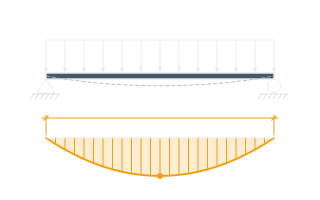
- Simply-supported beam under uniform load: maximum moment Mmax = wL²/8; rearranged to solve for allowable uniform load: w(max) = 8 x Mallow / L²
Inputs used
- Lintel Allowable Moment Capacity (kN·m)
- 15
- Clear Span
- 5 ft
Confidence note: This checks bending moment capacity only — the lintel must also satisfy shear capacity and deflection limits, both outside this calculator's scope, and this assumes a simple uniform load with no point loads or eccentricity.
What this calculation does not cover
- This is a bending check on a number you supply. It does not verify that the allowable moment you entered belongs to your lintel, and it never looks at end shear, deflection, or crushing of the masonry under the bearings. On a lintel carrying brittle masonry, or one over a window that has to keep opening, deflection usually governs long before bending does.
- The span field takes the clear opening, but a lintel spans between the centres of its end bearings, which is longer. Span is squared in the formula, so entering the bare opening returns more capacity than the member actually has. Add roughly one bearing length to the clear opening before entering it if you want the figure on the safe side.
- The answer is the total uniform load the section can carry, the lintel's own weight included. Nothing here knows what the lintel weighs, so subtract its self-weight from this figure before comparing what is left against the wall, floor and roof load coming down onto the opening.
- It models one simply supported member under one uniform line load. It does not split the load between the inner and outer leaves of a cavity wall, handle a lintel running continuously over two openings, or account for a beam, joist or truss landing as a point load anywhere over the span.
- Whether the moment you typed is a service (allowable) figure or a factored resistance decides what the answer means, and the calculator cannot tell them apart: a factored capacity returns a factored load, which must be compared against factored loads and not service loads. Forming or widening an opening in a loadbearing wall is engineered work in most jurisdictions, and this check does not replace those calculations or the approval that goes with them.
Add the equipment this sizes
This result is a specification — 3,540 lbf/ft — not a quantity. Put the thing it sizes into your project: how many, what you call it, and your supplier’s price.
Computed in your browser — nothing you enter is uploaded. Presented in US customary units and US trade terminology. Where a formula follows a published standard, that standard and its edition are cited beside it on this page; where none governs, the page says so. Local amendments override model codes — verify against the code in force where you build.
Sources checked 2026-09-06 · in the site-wide review of 2026-09-06 · v1.0.1
Regulatory standards & verification citations1
- Simply-supported beam under uniform load: maximum moment Mmax = wL²/8; rearranged to solve for allowable uniform load: w(max) = 8 x Mallow / L²
Cite this page
Your workspace
Most jobs need more than one number. Add the calculators you need next and they open right here, underneath this one — your figures stay on screen and nothing is lost to a page change.