
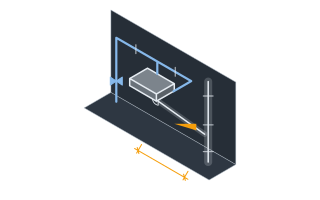
SettingsSettings for this calculationUS
The total straight-run length of pipe requiring freeze protection.
Measure the full length of pipe along its route, not the straight-line distance between endpoints if the pipe changes direction.
Extra cable length to allow for the additional wrap needed at elbows and bends.
Heat trace cable is typically run straight along a pipe, but bends and fittings add slightly more length than the straight-line pipe run — this allowance accounts for that.
The number of valves along the pipe run that need extra heat trace cable wrapped around their bodies.
Valves have irregular shapes and larger thermal mass than straight pipe, so they need additional cable wrapped around the valve body beyond the base run length.
The additional cable length allowed for wrapping each valve body.
Typically a manufacturer-recommended length per valve, based on the valve's size and shape.
Heat trace cable needed
186 ft
They open the calculator with your figures already in it
Pipe Freeze Protection Heat Trace Cable Length Calculator: 186 ft — shown in imperial, US market. The link sets both, so the result they see is the one on your screen.
Show calculation logicHide calculation logic
How this was calculated
Formula source(s)
- Total cable length = pipe length × (1 + fitting allowance) + valve count × extra cable per valve, accounting for the extra heat trace cable wrapped at valves and fittings beyond the base straight-run length
Inputs used
- Pipe Run Length
- 165 ft
- Fitting/Bend Allowance (%)
- 10
- Number of Valves
- 3
- Extra Cable per Valve
- 1.5 ft
What this calculation does not cover
- The allowance percentage cannot express a spiral. Where one straight pass does not deliver the watts per foot the pipe needs, the cable is wound around it at a set pitch, and the multiplier comes from that pitch — 1.4 or 2 times the pipe length, not the 10 to 25 percent this field accepts. Whether a single pass suffices depends on pipe diameter, insulation thickness and the design ambient, so settle that against the manufacturer's heat-loss table before treating the figure above as a quantity to buy.
- One length is not one circuit. Self-regulating cable draws heavy inrush when energized cold, and every cable type has a published maximum circuit length for a given supply voltage and breaker size — on the order of 100 to 150 m at 230 V, roughly half that at 120 V. A total beyond that has to be split across separate circuits on separate breakers, which changes the panel schedule, the conduit and the controller count.
- Terminations are not in the total. Each circuit needs a power connection kit and an end seal, each junction needs a splice or tee kit, and the cable has to reach from the pipe up to the junction box and along the sensor's route — it cannot simply be cut and taped. Cable also comes on fixed reel lengths, so a 56.5 m answer is a 60 or 75 m purchase.
Estimated cost — your price
This site holds no price list for this material — local prices vary too much to publish honestly. Enter your supplier's price and the result is costed with it.
Computed in your browser — nothing you enter is uploaded. Presented in US customary units and US trade terminology. Where a formula follows a published standard, that standard and its edition are cited beside it on this page; where none governs, the page says so. Local amendments override model codes — verify against the code in force where you build.
Sources checked 2026-09-06 · in the site-wide review of 2026-09-06 · v1.0.1
Regulatory standards & verification citations1
- Total cable length = pipe length × (1 + fitting allowance) + valve count × extra cable per valve, accounting for the extra heat trace cable wrapped at valves and fittings beyond the base straight-run length
Cite this page
Your workspace
Most jobs need more than one number. Add the calculators you need next and they open right here, underneath this one — your figures stay on screen and nothing is lost to a page change.
Protection this work requires
- Stop and check first. Textured ceiling coatings, board behind panels, floor tiles and bitumen adhesive in older buildings — built before asbestos was banned or phased out where you are — can contain asbestos, and drilling or sanding them releases fibres. Do not disturb it — have it sampled first. This is not a job for better PPE.
Tools and safety for this job
To first-fix electrical. Generic types, no brands, no prices.
- Assume every cable is live until proved dead at the point you will touch, with a two-pole tester you have just proved on a known source.
First-fix electrical: This site does not publish a tool list for electrical installation work. In every market it serves, fixed wiring is either reserved to a registered electrician or notifiable to a building authority, and the failure mode is a fire or an electrocution months later rather than a visibly bad job on the day. The calculator gives you the quantities to discuss and to buy against. The installation is a job for a qualified electrician, and the certificate they issue is the point of them.