
SettingsSettings for this calculationUS
The total plan area of the green roof to be covered by growing medium.
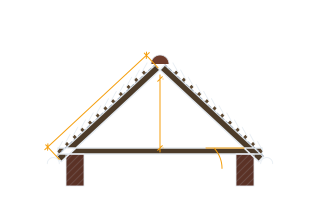
Use the plan (horizontal) area of the green roof system, not the roof's sloped surface area.
The design depth of the growing medium layer.
Extensive green roofs commonly use 75-150mm of growing medium, while intensive (garden-style) roofs may use 300mm or more — confirm the design depth from the landscape architect's or green roof system manufacturer's specification.
Growing medium volume needed
20 yd³
This is a simple plan-area-times-depth volume estimate — it does not account for compaction settling after installation or the growing medium's saturated weight, which the roof structure's capacity to support must be separately verified for (see the companion saturated load calculator).
They open the calculator with your figures already in it
Green Roof Growing Medium Volume Calculator: 20 yd³ — shown in imperial, US market. The link sets both, so the result they see is the one on your screen.
Show calculation logicHide calculation logic
How this was calculated
Formula source(s)
- Volume = Roof Area × Growing Medium Depth, a straightforward volumetric takeoff for the substrate/growing medium layer of an extensive or intensive green roof system, applied over the green roof's plan area.
Inputs used
- Green Roof Area
- 1080 sq ft
- Growing Medium Depth
- 6 in
Confidence note: This is a simple plan-area-times-depth volume estimate — it does not account for compaction settling after installation or the growing medium's saturated weight, which the roof structure's capacity to support must be separately verified for (see the companion saturated load calculator).
What this calculation does not cover
- Plan area is not planted area. A green roof carries vegetation-free zones — a ballast or paver border at the parapet and every roof edge, commonly 300-500 mm (12-20 in) wide, plus a clear ring around rooflights, upstands, penetrations and any maintenance path — and those take gravel or slab, not substrate. Deduct them before ordering, and resist filling them: they are there for wind uplift at the edge and for fire spread, and substrate in them removes both.
- This is the substrate layer alone, and the assembly beneath it is deeper. Root barrier, protection mat, drainage or reservoir board and filter fleece each add thickness, so the build-up standing on the deck is meaningfully more than the depth entered here. That total is what the upstand height, the flashing termination and any door threshold have to clear — designing the waterproofing details to the substrate depth on its own is how a roof ends up short of upstand above its own finished surface.
- Volume says nothing about what fills it. Green roof substrate is an engineered mineral blend to a specified grading with a small organic fraction; screened topsoil at the same depth is a different product — heavier when saturated, so the structural figure shifts, and fine enough to blind the filter fleece and hold water where the design wanted it drained away. Ordering on quantity alone is how the wrong material turns up in exactly the right amount.
Estimated cost — your price
This site holds no price list for this material — local prices vary too much to publish honestly. Enter your supplier's price and the result is costed with it.
Computed in your browser — nothing you enter is uploaded. Presented in US customary units and US trade terminology. Where a formula follows a published standard, that standard and its edition are cited beside it on this page; where none governs, the page says so. Local amendments override model codes — verify against the code in force where you build.
Sources checked 2026-09-06 · in the site-wide review of 2026-09-06 · v1.0.1
Regulatory standards & verification citations1
- Volume = Roof Area × Growing Medium Depth, a straightforward volumetric takeoff for the substrate/growing medium layer of an extensive or intensive green roof system, applied over the green roof's plan area.
Cite this page
Your workspace
Most jobs need more than one number. Add the calculators you need next and they open right here, underneath this one — your figures stay on screen and nothing is lost to a page change.