
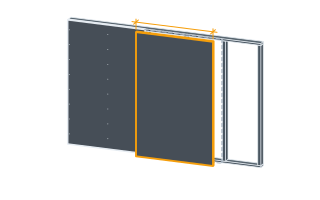
SettingsSettings for this calculationUS
The number of drywall butt joints that fall between framing members.
Count only the butt joints that land between studs or joists and therefore need added backing — joints that already fall on a framing member have support built in.
The length of blocking or backing installed behind each unsupported joint.
This is the length of solid backing (blocking, clips, or a backer board strip) installed to span behind a single butt joint.
Total backing length needed
16 ft
They open the calculator with your figures already in it
Gypsum Board Butt Joint Backing Calculator: 16 ft — shown in imperial, US market. The link sets both, so the result they see is the one on your screen.
Show calculation logicHide calculation logic
How this was calculated
Formula source(s)
- Backing length = number of unsupported butt joints × the backing piece length spanning each joint, ensuring every joint has solid backing even where it falls between framing members
Inputs used
- Number of Unsupported Butt Joints
- 4
- Backing Piece Length per Joint
- 4 ft
What this calculation does not cover
- The backing member's WIDTH is not part of this. A butt joint lands two cut board edges on one piece of blocking, and each edge needs enough bearing to take a screw held back from the crumbly cut arris — a nominal 2x4 laid flat presents about 89 mm (3.5 in) to share between them, roughly 44 mm (1.7 in) a side. Anything narrower, or a piece that ends up twisted out of plane, puts fasteners into the edge of the core where they hold nothing and the joint moves anyway.
- How many unsupported joints exist at all is a decision made when the boards are ordered, not a fact about the wall. A room boarded in 3.6 m lengths across 3.4 m runs has no butt joints to back; the same room in 2.4 m sheets has one in every run and needs this quantity. Fix the sheet length first, because the cheapest backing is the backing you designed out.
Estimated cost — your price
This site holds no price list for this material — local prices vary too much to publish honestly. Enter your supplier's price and the result is costed with it.
Computed in your browser — nothing you enter is uploaded. Presented in US customary units and US trade terminology. Where a formula follows a published standard, that standard and its edition are cited beside it on this page; where none governs, the page says so. Local amendments override model codes — verify against the code in force where you build.
Sources checked 2026-09-06 · in the site-wide review of 2026-09-06 · v1.0.1
Regulatory standards & verification citations1
- Backing length = number of unsupported butt joints × the backing piece length spanning each joint, ensuring every joint has solid backing even where it falls between framing members
Cite this page
Your workspace
Most jobs need more than one number. Add the calculators you need next and they open right here, underneath this one — your figures stay on screen and nothing is lost to a page change.
Tools and safety for this job
To hang plasterboard and cut board around openings and boxes. Generic types, no brands, no prices.
Protection this work requires
- Joint-compound dust is very fine and travels: a P1/FFP1 mask is the minimum, and a damp-sponge finish avoids most of it.
- Boards, blocks and bagged material cause most lasting back injuries on small sites: two people or a lifter for full sheets, and never a bag on one shoulder up a ladder.
- Knives cause more site injuries than any power tool: cut away from your body, change blades often, and wear cut-resistant gloves to EN 388 level C for repeated cutting.
Show the 9 tools this job needsHide tools
Essential
Cordless drill/driver
Drywall saw
Tape measure
Utility knife
Recommended
Board lifter
Combination or framing square
Drywall screw gun
Optional
Oscillating multi-tool
Panel lift
Also needed as materials: drill and driver bits, oscillating blades, replacement blades.
what each drywall tool is for, and the spec that decides which to buy where one does.