Materials & Quantities

Air Barrier Sealant Tape Linear Footage Calculator

Calculate the air barrier seam tape needed to seal sheathing joints and penetrations, with waste allowance.

  • Answers as you type
  • Every formula cited
  • Calculated in your browser
SettingsSettings for this calculationUS
Market
Imperial · sales tax
Who is doing the work?

Waste is set to 5% by hand. Pick a tier above to replace it, or keep your own figure.

The combined length of all sheathing seams and penetrations to be taped.

Sum the length of every sheathing joint, panel edge, and penetration perimeter that the air barrier tape needs to seal.

Extra tape to allow for cut waste, overlaps, and rework.

5% is typical for a straightforward layout; increase it for complex penetration patterns or numerous corners.

Seam tape needed

204.7 ft

High confidence
Then change the inputs to see how far the answer moves.

Show calculation logic

How this was calculated

Formula source(s)

  • Total seam tape = total seam length × (1 + waste allowance), the standard method for estimating continuous air barrier seam tape

Inputs used

Total Seam Length
195 ft
Waste Allowance (%)
5
Final result204.75 ft

What this calculation does not cover

  • One length, several different products. A flat sheathing seam takes a straight tape; an inside or outside corner takes a stretch or flexible tape that will turn the angle without tenting; a round penetration or a lapped transition often takes liquid-applied flashing and no tape at all. Those are separate purchases in separate widths sold in fixed roll lengths, and one total silently averages them — buy against it and the corners are the part that comes up short.
  • Taping the perimeter of a rough opening is an AIR seal, not a water detail. Water needs a sloped or pan-formed sill and laps that shingle downward, head over jamb over sill, so anything getting past the window is led back out. Tape run continuously around an opening as an air seal can instead hold water against the sheathing, and that failure shows up as rot at the sill years before anyone opens the wall.

Estimated cost — your price

This site holds no price list for this material — local prices vary too much to publish honestly. Enter your supplier's price and the result is costed with it.

195 ft
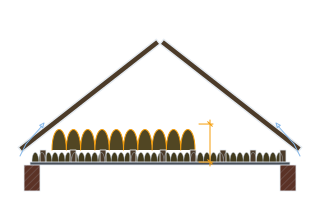
Schematic, drawn to the proportions you entered — not to scale on screen.

Computed in your browser — nothing you enter is uploaded. Presented in US customary units and US trade terminology. Where a formula follows a published standard, that standard and its edition are cited beside it on this page; where none governs, the page says so. Local amendments override model codes — verify against the code in force where you build.

Sources checked 2026-09-06 · in the site-wide review of 2026-09-06 · v1.0.1

Regulatory standards & verification citations1
  1. Total seam tape = total seam length × (1 + waste allowance), the standard method for estimating continuous air barrier seam tape
Cite this page

Your workspace

Most jobs need more than one number. Add the calculators you need next and they open right here, underneath this one — your figures stay on screen and nothing is lost to a page change.

Now that you have the number

These guides cover the work this quantity is for — the first ones run this calculator inside the section that raises the question.

How to calculate air barrier sealant tape linear footage in 3 steps

  1. Total Seam LengthThe combined length of all sheathing seams and penetrations to be taped.
  2. Waste Allowance (%)Extra tape to allow for cut waste, overlaps, and rework.
  3. Seam tape neededThe tool computes the seam tape needed from those figures and shows the formula, its sources, and a confidence rating alongside it.

Seam tape needed by total seam length

Page defaults, not your figures above.

Total Seam LengthSeam tape needed (ft)
100 ft105
150 ft157
200 ft210
250 ft263
300 ft315
350 ft368

Frequently asked questions

Which joints actually need taping?
Every joint in the air barrier plane: sheathing panel edges, the perimeter of each rough opening, and every service penetration. Then the transitions that people forget — wall to foundation, wall to roof deck, and around anything that passes through. Those transitions are a small fraction of the tape and a large fraction of the leakage.
Do I need primer?
On OSB, usually yes. On a dusty or cold substrate, usually yes. Acrylic and butyl tapes lose grip on porous or contaminated surfaces, and most manufacturers state a minimum application temperature below which primer becomes mandatory rather than optional. It is a separate cost and a separate operation, and skipping it is why tape lets go in the first winter.
Does taping the sheathing make the building airtight?
It makes one plane airtight. Airtightness is a property of the whole enclosure, and a perfectly taped wall connected badly to the roof leaks at the connection. The only way to know is to test — a blower door finds in an hour what a tape schedule cannot tell you at all.
How much extra should I order?
About 5% over the measured seam length for a straightforward layout, and more for complex penetration patterns or numerous corners: enough that nobody is tempted to stretch it. Running short of air barrier tape mid-elevation produces a joint someone decides to leave, and that decision is invisible once the cladding is on. It is a low-cost material guarding a defect that is expensive to find later.
Preliminary estimate, not certified engineering. This tool produces an indicative quantity calculation for planning purposes only — it is not a certified structural analysis, a guaranteed material takeoff, or a substitute for building department approval. Always verify measurements on-site and have a licensed contractor or structural engineer review any load-bearing, code-sensitive, or safety-critical work before purchasing materials or starting construction. Spotted an arithmetic or standards error? Report it to contact@craftquantities.com with your inputs — a confirmed fix gets a permanent check of its own, so the same mistake cannot come back.