
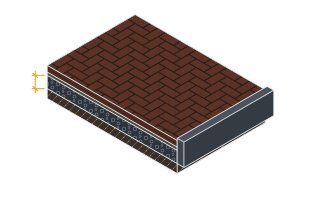
SettingsSettings for this calculationUS
The standard allowance most suppliers and estimating guides assume for ordinary work.
Length of the paved area.
Measure to the outside face of the EDGE RESTRAINT rather than to the last paver. The restraint is part of the build, it needs base beneath it, and on a large area the strip it occupies around the perimeter is a real quantity. Taking the paved face instead under-orders the base consistently, and the shortfall lands at the edges where settlement is most visible.
Width of the paved area.
The width to build to on a drive is the one a vehicle needs at its TIGHTEST point, which is a turn or an entrance rather than a straight run — a drive wide enough along its length and pinched at the gate is pinched. Decide it before the base goes in: widening afterwards means lifting the edge restraint on one or both sides and rebuilding the base under it, which is most of the job again.
What will use the surface.
Sub-base depth is the single decision that determines whether the paving is still flat in five years. Building a driveway on a patio sub-base is the most common cause of rutting and settlement.
Screeded sand layer under the units.
25-40 mm, screeded level and left uncompacted before the units go down. Thicker bedding is not better — it consolidates unevenly under load and produces exactly the dips it was meant to avoid.
Allowance for cuts and breakage.
10% for a rectangular area laid square; 15% or more for a diagonal pattern or a curved edge, where every perimeter unit is cut.
Paving area
279 sq ft
Sub-base includes a 25% compaction allowance. Depths follow common guidance and should give way to a specific specification where one exists.
- Net paved area
- 253.5 sq ft
- Sub-base depth
- 3.94 in
- Sub-base to order (loose)
- 3.85 yd³
- Sub-base weight
- 10,384.18 lb
- Bedding sand
- 0.98 yd³
- Area in sq ft
- 278.85 sq ft
They open the calculator with your figures already in it
Hardscape Area & Base Calculator: 279 sq ft — shown in imperial, US market. The link sets both, so the result they see is the one on your screen.
Show calculation logicHide calculation logic
How this was calculated
Formula source(s)
- Sub-base depth: 100 mm compacted for pedestrian paving, 150-200 mm for vehicular — BS 7533 and ICPI guidance
- Bedding layer 25-40 mm of sharp sand, screeded and not compacted before laying — ICPI Tech Spec 2
Inputs used
- Length
- 19.5 ft
- Width
- 13 ft
- Traffic
- Pedestrian — patio, path (4 in sub-base)
- Bedding sand depth
- 1.25 in
- Cutting waste (%)
- 10
Intermediate steps
- Net paved area
- 253.5 sq ft
- Sub-base depth
- 3.94 in
- Sub-base to order (loose)
- 3.85 yd³
- Sub-base weight
- 10,384.18 lb
- Bedding sand
- 0.98 yd³
- Area in sq ft
- 278.85 sq ft
Confidence note: Sub-base includes a 25% compaction allowance. Depths follow common guidance and should give way to a specific specification where one exists.
What this calculation does not cover
- Assumes a competent subgrade. Soft or clay ground needs excavation to a firm formation and usually a geotextile separator, neither of which is calculated here.
- No allowance for edge restraint, which paving needs on every free edge or it spreads.
Estimated cost — your price
This site holds no price list for this material — local prices vary too much to publish honestly. Enter your supplier's price and the result is costed with it.
Computed in your browser — nothing you enter is uploaded. Presented in US customary units and US trade terminology. Where a formula follows a published standard, that standard and its edition are cited beside it on this page; where none governs, the page says so. Local amendments override model codes — verify against the code in force where you build.
Sources checked 2026-09-05 · in the site-wide review of 2026-09-06 · v1.0.1
Regulatory standards & verification citations2
- Sub-base depth: 100 mm compacted for pedestrian paving, 150-200 mm for vehicular — BS 7533 and ICPI guidance
- Bedding layer 25-40 mm of sharp sand, screeded and not compacted before laying — ICPI Tech Spec 2
Cite this page
Your workspace
Most jobs need more than one number. Add the calculators you need next and they open right here, underneath this one — your figures stay on screen and nothing is lost to a page change.
Tools and safety for this job
To lay paving. Generic types, no brands, no prices.
Protection this work requires
- Cutting or grinding concrete, masonry, screed, tile or fibre-cement board releases respirable silica: cut wet or extract at the tool, and wear a P2/N95 respirator at minimum — a nuisance dust mask does not filter it.
- Saws, grinders and breakers run above 85 dB, where hearing damage accumulates and does not recover: defenders or plugs for every cut, not just the long ones.
- Breakers and grinders cause permanent nerve damage: limit continuous trigger time, keep hands warm, and stop if fingers tingle or blanch.
- Boards, blocks and bagged material cause most lasting back injuries on small sites: two people or a lifter for full sheets, and never a bag on one shoulder up a ladder.
Show the 8 tools this job needsHide tools
Essential
Plate compactor
Rubber mallet
Shovel and spade
Spirit level
String line and pins
Wheelbarrow
Recommended
Block splitter
Optional
Angle grinder
Also needed as materials: cutting and diamond discs.
what each landscaping tool is for, and the spec that decides which to buy where one does.