
SettingsSettings for this calculationUS
The hours the first repetition took, or is expected to take.
Crew hours or clock hours — whichever you want the answer in. The first unit carries the setting out, the questions and the mistakes, which is what the curve then takes away.
The percentage the time falls to each time the number of units doubles.
At 90%, the second unit (or the average of the first two, under Wright's model) takes 90% of the first, the fourth 90% of the second, and so on. 100% means no learning. Measure it from your own repeated work: the rate belongs to a crew, a task and a model, and the same data gives different rates under the two models.
How many repetitions in the run.
Houses on an estate, typical floors of a building, identical precast lifts, or any task repeated by the same crew.
Which quantity the learning rate applies to.
Use the model your rate was measured under. Crawford's rate describes the time of each unit; Wright's describes the average of all the units so far, which falls more slowly than the latest unit does. The same rate gives a shorter total under Wright's model.
Total time for the run
584 hours
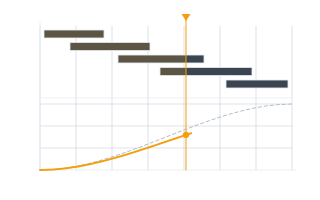
Under Crawford's unit model at 90%, 20 units take 584.3 hours against 800.0 with no learning, and the last takes 25.4. The answer is only as good as the rate, which belongs to a crew and a task and is best measured from the first few units.
- Time for unit 20, the last
- 25.37 hours
- Average time per unit
- 29.22 hours
- Time the run would take with no learning
- 800 hours
- Time the learning saves
- 215.69 hours
They open the calculator with your figures already in it
Repetition Learning Curve Calculator (Wright and Crawford): 584 hours — shown in imperial, US market. The link sets both, so the result they see is the one on your screen.
Show calculation logicHide calculation logic
How this was calculated
Formula source(s)
- Crawford's unit learning curve: the time for the nth unit is T1 × n^b, where b = log(learning rate) ÷ log 2, so each doubling of the quantity multiplies the unit time by the learning rate; the run's total is the sum of the unit times
- Wright's cumulative average learning curve (T. P. Wright, 1936, Factors Affecting the Cost of Airplanes): the average time over the first n units is T1 × n^b, so the run's total is n times that average and the nth unit takes the difference between successive totals; the same rate gives a different answer under the two models
Inputs used
- Time for the First Unit (hours)
- 40
- Learning Rate (%)
- 90
- Number of Units
- 20
- Learning Curve Model
- Crawford — each unit's own time falls
Intermediate steps
- Time for unit 20, the last
- 25.37 hours
- Average time per unit
- 29.22 hours
- Time the run would take with no learning
- 800 hours
- Time the learning saves
- 215.69 hours
Confidence note: Under Crawford's unit model at 90%, 20 units take 584.3 hours against 800.0 with no learning, and the last takes 25.4. The answer is only as good as the rate, which belongs to a crew and a task and is best measured from the first few units.
What this calculation does not cover
- It assumes the same crew repeats the same task without a break. A new crew, a long gap or a design change resets some of the learning, which the curve does not know.
- Learning does not continue for ever: crews reach a floor set by the work itself. Over a long run the curve understates the time for the later units.
- The two models give different answers at the same rate. A rate measured under one model should not be used in the other.
Computed in your browser — nothing you enter is uploaded. Presented in US customary units and US trade terminology. Where a formula follows a published standard, that standard and its edition are cited beside it on this page; where none governs, the page says so. Local amendments override model codes — verify against the code in force where you build.
Sources checked 2026-09-22 · v1.0.0
Regulatory standards & verification citations2
- Crawford's unit learning curve: the time for the nth unit is T1 × n^b, where b = log(learning rate) ÷ log 2, so each doubling of the quantity multiplies the unit time by the learning rate; the run's total is the sum of the unit times
- Wright's cumulative average learning curve (T. P. Wright, 1936, Factors Affecting the Cost of Airplanes): the average time over the first n units is T1 × n^b, so the run's total is n times that average and the nth unit takes the difference between successive totals; the same rate gives a different answer under the two models
Cite this page
Your workspace
Most jobs need more than one number. Add the calculators you need next and they open right here, underneath this one — your figures stay on screen and nothing is lost to a page change.