
SettingsSettings for this calculationUS
How long activity A takes, in working days.
The activity's own duration, from the quantity and the crew. Zero leaves it out of the network, along with any link to it.
How long activity B takes, in working days.
The activity's own duration, from the quantity and the crew. Zero leaves it out of the network, along with any link to it.
An activity that must finish before B can start.
Only earlier activities are offered, so the network can never loop back on itself. Leave it at None if the activity can start as soon as the job does.
An activity that must finish before B can start.
Only earlier activities are offered, so the network can never loop back on itself. Leave it at None if the activity can start as soon as the job does.
How long activity C takes, in working days.
The activity's own duration, from the quantity and the crew. Zero leaves it out of the network, along with any link to it.
An activity that must finish before C can start.
Only earlier activities are offered, so the network can never loop back on itself. Leave it at None if the activity can start as soon as the job does.
An activity that must finish before C can start.
Only earlier activities are offered, so the network can never loop back on itself. Leave it at None if the activity can start as soon as the job does.
How long activity D takes, in working days.
The activity's own duration, from the quantity and the crew. Zero leaves it out of the network, along with any link to it.
An activity that must finish before D can start.
Only earlier activities are offered, so the network can never loop back on itself. Leave it at None if the activity can start as soon as the job does.
An activity that must finish before D can start.
Only earlier activities are offered, so the network can never loop back on itself. Leave it at None if the activity can start as soon as the job does.
How long activity E takes, in working days.
The activity's own duration, from the quantity and the crew. Zero leaves it out of the network, along with any link to it.
An activity that must finish before E can start.
Only earlier activities are offered, so the network can never loop back on itself. Leave it at None if the activity can start as soon as the job does.
An activity that must finish before E can start.
Only earlier activities are offered, so the network can never loop back on itself. Leave it at None if the activity can start as soon as the job does.
How long activity F takes, in working days.
The activity's own duration, from the quantity and the crew. Zero leaves it out of the network, along with any link to it.
An activity that must finish before F can start.
Only earlier activities are offered, so the network can never loop back on itself. Leave it at None if the activity can start as soon as the job does.
An activity that must finish before F can start.
Only earlier activities are offered, so the network can never loop back on itself. Leave it at None if the activity can start as soon as the job does.
Length of the programme
17 days
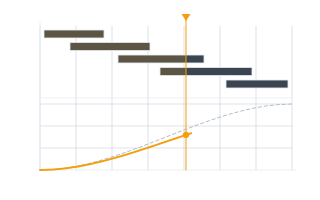
The programme takes 17 working days. The critical activities — zero float, where a day lost is a day on the end — are A, B, D, E, F. The nearest to becoming critical is C, with 1 day of float. Float belongs to the path, not to one activity: using it up on one activity takes it from the others on the same path.
- Activity A: total float (early start day 0, late start day 0)
- 0 days
- Activity B: total float (early start day 5, late start day 5)
- 0 days
- Activity C: total float (early start day 5, late start day 6)
- 1 day
- Activity D: total float (early start day 8, late start day 8)
- 0 days
- Activity E: total float (early start day 12, late start day 12)
- 0 days
- Activity F: total float (early start day 14, late start day 14)
- 0 days
They open the calculator with your figures already in it
Critical Path and Float Calculator (CPM): 17 days — shown in imperial, US market. The link sets both, so the result they see is the one on your screen.
Show calculation logicHide calculation logic
How this was calculated
Formula source(s)
- The critical path method, Kelley and Walker (1959): a forward pass sets each activity's early start as the latest early finish of the activities it follows, a backward pass sets its late finish as the earliest late start of the activities that follow it, and total float is late start minus early start
- Critical activities are those with zero total float; any delay to one of them delays the end of the programme by the same amount, while an activity with float can slip by up to its float without moving the end
Inputs used
- Activity A Duration (days, 0 to leave out)
- 5
- Activity B Duration (days, 0 to leave out)
- 3
- Activity B: First Activity It Follows
- Activity A
- Activity B: Second Activity It Follows
- None
- Activity C Duration (days, 0 to leave out)
- 6
- Activity C: First Activity It Follows
- Activity A
- Activity C: Second Activity It Follows
- None
- Activity D Duration (days, 0 to leave out)
- 4
- Activity D: First Activity It Follows
- Activity B
- Activity D: Second Activity It Follows
- None
- Activity E Duration (days, 0 to leave out)
- 2
- Activity E: First Activity It Follows
- Activity C
- Activity E: Second Activity It Follows
- Activity D
- Activity F Duration (days, 0 to leave out)
- 3
- Activity F: First Activity It Follows
- Activity E
- Activity F: Second Activity It Follows
- None
Intermediate steps
- Activity A: total float (early start day 0, late start day 0)
- 0 days
- Activity B: total float (early start day 5, late start day 5)
- 0 days
- Activity C: total float (early start day 5, late start day 6)
- 1 day
- Activity D: total float (early start day 8, late start day 8)
- 0 days
- Activity E: total float (early start day 12, late start day 12)
- 0 days
- Activity F: total float (early start day 14, late start day 14)
- 0 days
Confidence note: The programme takes 17 working days. The critical activities — zero float, where a day lost is a day on the end — are A, B, D, E, F. The nearest to becoming critical is C, with 1 day of float. Float belongs to the path, not to one activity: using it up on one activity takes it from the others on the same path.
What this calculation does not cover
- Finish-to-start links only, with no lags: each activity starts when everything it follows has finished. Overlaps, lead-ins and waiting times need a scheduling program.
- Six activities. Real programmes have hundreds, and this is for checking a small sequence or learning how float is found, not for running a job.
- Durations are in working days and the result is too. The working-days calculator turns it into calendar days.
Computed in your browser — nothing you enter is uploaded. Presented in US customary units and US trade terminology. Where a formula follows a published standard, that standard and its edition are cited beside it on this page; where none governs, the page says so. Local amendments override model codes — verify against the code in force where you build.
Sources checked 2026-09-22 · v1.0.0
Regulatory standards & verification citations2
- The critical path method, Kelley and Walker (1959): a forward pass sets each activity's early start as the latest early finish of the activities it follows, a backward pass sets its late finish as the earliest late start of the activities that follow it, and total float is late start minus early start
- Critical activities are those with zero total float; any delay to one of them delays the end of the programme by the same amount, while an activity with float can slip by up to its float without moving the end
Cite this page
Your workspace
Most jobs need more than one number. Add the calculators you need next and they open right here, underneath this one — your figures stay on screen and nothing is lost to a page change.