
SettingsSettings for this calculationUS
The alarm symbols on the drawing, or the number the placement rules give you.
A count from the plan takeoff arrives here as it is. Combined smoke and carbon monoxide units count once; separate carbon monoxide alarms are a run of their own.
Wired alarms need a base and cable; battery-only ones need neither.
New homes in the US are wired with a battery backup, and in the UK a Grade D1 system pairs the mains with a sealed long-life cell. A radio-linked battery alarm talks to the others without any cable.
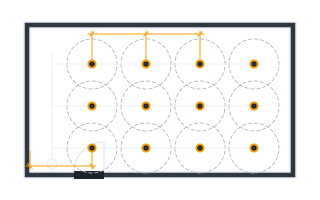
Your measured route from the previous alarm, or the supply for the first, through ceiling and walls.
Measure across the ceiling joists and down to wherever the supply comes from, rather than in a straight line between the symbols. Replace the opening figure with your own; it only has to be right on average across the run.
Tools needed: Scale rule or the plan takeoff
Cells each alarm takes, from its box: often one 9 V, sometimes two or three AA.
Ignored for a sealed type, whose cell is built in and lasts the alarm's life.
Extra over the measured runs, for tails at each base and the route round obstacles.
Zero leaves the measured runs as they are.
Smoke alarms
5 alarms
Mains, replaceable backup battery: 5 bases and the cable on your runs, 5 batteries. Where the alarms go and which grade the home needs are set by the code where you build; the wiring is for a qualified or licensed electrician.
- Mounting bases
- 5 bases
- Interconnect cable
- 82.5 ft · 82 ft 6 in
- Interconnect cable before the allowance
- 75 ft
- Batteries to fit
- 5 batteries
They open the calculator with your figures already in it
Smoke Alarm Fit-Out Calculator (Alarms, Mounting Bases, Interconnect Cable and Batteries): 5 alarms — shown in imperial, US market. The link sets both, so the result they see is the one on your screen.
Show calculation logicHide calculation logic
How this was calculated
Formula source(s)
- International Residential Code (2021), R314.4 and R314.6: where more than one smoke alarm is required in a dwelling unit they are interconnected so that one sounding sounds them all, and their primary power is from the building wiring with a battery backup (physical or wireless interconnection is allowed where the code says so)
- BS 5839-6:2019+A1:2020, Fire detection and fire alarm systems for buildings, Part 6: Grade D1 is mains-powered alarms with a tamper-proof standby supply of a long-life battery, Grade D2 mains-powered alarms with a user-replaceable standby battery, and Grade F battery-powered alarms
Inputs used
- Number of Smoke Alarms
- 5
- How They Are Powered
- Mains, replaceable backup battery
- Cable Run to Each Alarm
- 15 ft
- Batteries per Alarm
- 1
- Cable Allowance (%)
- 10
Intermediate steps
- Mounting bases
- 5 bases
- Interconnect cable
- 82.5 ft
- Interconnect cable before the allowance
- 75 ft
- Batteries to fit
- 5 batteries
Confidence note: Mains, replaceable backup battery: 5 bases and the cable on your runs, 5 batteries. Where the alarms go and which grade the home needs are set by the code where you build; the wiring is for a qualified or licensed electrician.
What this calculation does not cover
- Positions and numbers are not checked. Where alarms must go is set by the code where you build (the residential code's list of bedrooms, hallways and levels in the US, the grade and category under BS 5839-6 in the UK), and the smoke detector placement page works through that list.
- The cable is the run you enter for each alarm with your allowance on top. It assumes one cable carrying the supply and the interconnect from alarm to alarm; a separate supply to each alarm, a home run, or a heat alarm in a kitchen on a different link changes it. The cable's type and size, and the circuit, are a qualified electrician's.
- Bases are counted one per wired alarm. Most makers ship the base in the alarm's box, so check before ordering them separately; a replacement alarm fitted to an existing base may need an adapter instead.
- Batteries are one set for fitting, not the replacements over the alarm's life. A maker's instructions say how often a replaceable cell is changed and when the whole alarm is replaced.
- Smoke, heat and carbon monoxide alarms often share one interconnect, but a carbon monoxide alarm is its own count; enter it as a separate run.
Estimated cost — your price
This site holds no price list for this material — local prices vary too much to publish honestly. Enter your supplier's price and the result is costed with it.
Computed in your browser — nothing you enter is uploaded. Presented in US customary units and US trade terminology. Where a formula follows a published standard, that standard and its edition are cited beside it on this page; where none governs, the page says so. Local amendments override model codes — verify against the code in force where you build.
Sources checked 2026-10-31 · 4 test vectors · v1.0.0
Regulatory standards & verification citations2
- International Residential Code (2021), R314.4 and R314.6: where more than one smoke alarm is required in a dwelling unit they are interconnected so that one sounding sounds them all, and their primary power is from the building wiring with a battery backup (physical or wireless interconnection is allowed where the code says so)
- BS 5839-6:2019+A1:2020, Fire detection and fire alarm systems for buildings, Part 6: Grade D1 is mains-powered alarms with a tamper-proof standby supply of a long-life battery, Grade D2 mains-powered alarms with a user-replaceable standby battery, and Grade F battery-powered alarms
Which documents these citations point at
- International Residential Code (United States)One- and two-family dwellings and townhouses up to three storeys — structure, fire safety, energy, plumbing, mechanical and electrical in a single document.
A code or standard has force only where a jurisdiction has adopted it, usually with local amendments. This site holds no adoption data for any authority, so check what is in force with the authority where you build. Any section cited above without an edition should be checked against the edition in force where you build. What it would take to know.
Cite this page
Your workspace
Most jobs need more than one number. Add the calculators you need next and they open right here, underneath this one — your figures stay on screen and nothing is lost to a page change.