
SettingsSettings for this calculationUS
Water volume.
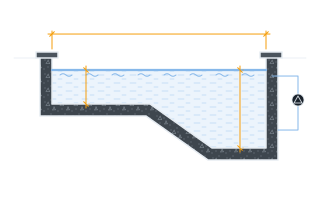
For turnover, which is about passing the whole body of water through the filter within a target time — so what is needed is the actual contained volume rather than a nominal capacity. On a pool with a deep end, the average depth is NOT the mean of the shallow and deep readings unless the floor slopes uniformly the whole way; a flat shallow section with a short slope to a deep end holds far less than that average implies.
Complete circulations of the whole volume each day.
One per day suits a lightly used residential pool; two where bather load is high or the pool is warm. Commercial pools are regulated and require considerably more.
Hours the pump actually runs.
Fewer hours means a higher flow rate for the same turnover, which costs more energy per litre moved. A variable-speed pump run longer at lower speed uses dramatically less energy for the same turnover — the affinity laws mean power falls with the cube of speed.
Flow rate required
27.52 gal/min
Flow required at the pump. The pump must deliver this against the system's actual head, which is a separate calculation.
- Flow rate in m³/hr (metric filter and pump rating basis)
- 6.25 m³/hr
- Volume circulated per day
- 65.4 yd³
- Turnover time
- 8 hours
They open the calculator with your figures already in it
Pool Pump Turnover Calculator: 27.52 gal/min — shown in imperial, US market. The link sets both, so the result they see is the one on your screen.
Show calculation logicHide calculation logic
How this was calculated
Formula source(s)
- Residential pools are commonly designed for one to two complete turnovers per day — APSP/PHTA design standards
- Turnover rate = pool volume ÷ desired turnover time
Inputs used
- Pool volume
- 13210 gal
- Turnovers per day
- 1
- Pump run hours per day
- 8
Intermediate steps
- Flow rate in m³/hr (metric filter and pump rating basis)
- 6.25 m³/hr
- Volume circulated per day
- 65.4 yd³
- Turnover time
- 8 hours
Confidence note: Flow required at the pump. The pump must deliver this against the system's actual head, which is a separate calculation.
What this calculation does not cover
- Says nothing about head. A pump rated at this flow on an open discharge will deliver less through a filter, heater and long pipe run.
- Filter and pipe sizing cap the flow that can be used. Pushing more through an undersized filter shortens its life and reduces its effectiveness.
Add the equipment this sizes
This result is a specification — 27.52 gal/min — not a quantity. Put the thing it sizes into your project: how many, what you call it, and your supplier’s price.
Computed in your browser — nothing you enter is uploaded. Presented in US customary units and US trade terminology. Where a formula follows a published standard, that standard and its edition are cited beside it on this page; where none governs, the page says so. Local amendments override model codes — verify against the code in force where you build.
Sources checked 2026-09-06 · in the site-wide review of 2026-09-06 · v1.0.1
Regulatory standards & verification citations2
- Residential pools are commonly designed for one to two complete turnovers per day — APSP/PHTA design standards
- Turnover rate = pool volume ÷ desired turnover time
Cite this page
Your workspace
Most jobs need more than one number. Add the calculators you need next and they open right here, underneath this one — your figures stay on screen and nothing is lost to a page change.