
SettingsSettings for this calculationUS
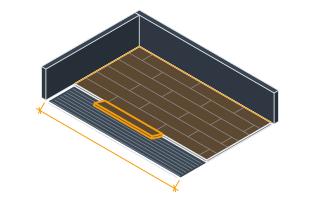
The area taking primer, measured to the walls.
Prime right out to the perimeter even where a skirting will cover it, because the edge is where a levelling compound is thinnest and where a dusty, unprimed strip shows up first as a line of failed bond. Deduct fixed units that will not be lifted and nothing else.
The area one unit of the MIXED, diluted primer covers.
Most floor primer data sheets publish coverage for the mix at a stated dilution rather than for the neat product, which is what this page assumes. Check which yours gives — the two differ by exactly the dilution factor, and reading one as the other is how a job ends up with twice or half the primer it needed.
1 means a 1:1 mix. 0 means the primer goes on neat.
The instructions give this against the substrate, and the field test behind it is the one the guide describes: put a drop of water on the base and watch. Gone in seconds means an absorbent base and a thinner, more dilute first coat that can actually penetrate; sitting as a bead means a dense base that wants the primer neat or close to it. A dilute coat on a dense floor never keys, and a neat coat on a thirsty one skins over dust it has not bound.
How many passes the substrate needs.
A very absorbent base often takes a dilute first coat to penetrate and bind, then a second at a lower dilution to seal. Where that is the specification, run this page twice — once per coat at its own dilution — rather than putting two coats at one ratio, because the two coats are deliberately different mixes.
The volume of one container of NEAT primer as sold.
The container count on this page is of neat product, because that is what you buy — the water is yours. It is also the figure that makes dilution worth calculating at all: at 1:1 a floor that looks like it needs twenty litres of primer needs ten, and the other ten come out of a tap.
Neat primer needed
0.492 gal
The arithmetic is exact. Both figures it rests on — the coverage rate and the dilution ratio — are the primer manufacturer's, and this page assumes the rate is published for the MIXED product, which is how most are written but not all.
- Containers of neat primer to buy
- 1 container
- Water to add
- 0.49 gal
- Mixed primer this makes
- 0.98 gal
- Neat primer left in the last container
- 0.51 gal
They open the calculator with your figures already in it
Floor Primer Dilution and Coverage Calculator: 0.4923 gal — shown in imperial, US market. The link sets both, so the result they see is the one on your screen.
Show calculation logicHide calculation logic
How this was calculated
Formula source(s)
- Mixed volume = area × coats ÷ the coverage rate published for the MIXED primer; neat primer = mixed volume ÷ (1 + parts of water per part of primer); the water is the remainder
- Dilution ratio, coverage rate and the number of coats are all product data from the primer manufacturer's instructions, which set them against the absorbency of the substrate — there is no general dilution for floor primer
Inputs used
- Floor Area Being Primed
- 320 sq ft
- Published Coverage Rate of the Mixed Primer
- 325 ft²/gal
- Parts of Water per Part of Primer
- 1
- Number of Coats
- 1
- Container Size Supplied
- 1 gal
Intermediate steps
- Containers of neat primer to buy
- 1 container
- Water to add
- 0.49 gal
- Mixed primer this makes
- 0.98 gal
- Neat primer left in the last container
- 0.51 gal
Confidence note: The arithmetic is exact. Both figures it rests on — the coverage rate and the dilution ratio — are the primer manufacturer's, and this page assumes the rate is published for the MIXED product, which is how most are written but not all.
What this calculation does not cover
- It does not choose your dilution. That is set by how absorbent the base is and by the primer's own instructions, and the two together are the whole decision.
- It assumes the published coverage rate is for the MIXED primer, which is how most are written. A rate published for neat product is a different sum — divide the area by that rate directly and read the neat figure off the top line.
- A membrane, a damp-proof surface or an old adhesive residue is usually not a dilution question at all: those call for the system's own named product or a sand broadcast, and diluting anything onto them is the wrong move rather than a cheaper one.
Estimated cost — your price
This site holds no price list for this material — local prices vary too much to publish honestly. Enter your supplier's price and the result is costed with it.
Computed in your browser — nothing you enter is uploaded. Presented in US customary units and US trade terminology. Where a formula follows a published standard, that standard and its edition are cited beside it on this page; where none governs, the page says so. Local amendments override model codes — verify against the code in force where you build.
Sources checked 2026-09-20 · v1.0.0
Regulatory standards & verification citations2
- Mixed volume = area × coats ÷ the coverage rate published for the MIXED primer; neat primer = mixed volume ÷ (1 + parts of water per part of primer); the water is the remainder
- Dilution ratio, coverage rate and the number of coats are all product data from the primer manufacturer's instructions, which set them against the absorbency of the substrate — there is no general dilution for floor primer
Cite this page
Your workspace
Most jobs need more than one number. Add the calculators you need next and they open right here, underneath this one — your figures stay on screen and nothing is lost to a page change.
Protection this work requires
- Stop and check first. Paint under later coats in older housing can be lead-based, and sanding or heat-stripping it produces lead dust that is especially harmful to children and to anyone pregnant. Test before you disturb it — this is a job for a tested, controlled method, not a better mask.
Tools and safety for this job
To roll and cut in two coats and prepare a surface for paint. Generic types, no brands, no prices.
- Joint-compound dust is very fine and travels: a P1/FFP1 mask is the minimum, and a damp-sponge finish avoids most of it.
- A dust mask does nothing about solvent vapour: ventilate through, and use an organic-vapour (A1) cartridge respirator in an enclosed room.
- Most fatal falls on small jobs are from under three metres: use a tower or a ladder tied at the top, and never work off the top two rungs.
Show the 11 tools this job needsHide tools
Essential
Brushes
Dust sheets and masking
Filling knife
Roller frame, sleeves and tray
Scraper
Recommended
Caulking gun
Extension pole
Pole sander
Random orbital sander
Step ladder
Optional
Dust extractor or vacuum with a fine filter
Also needed as materials: abrasive discs, caulk and sealant cartridges, masking tape, plastic sheeting, roller sleeves, sanding screens or paper.
what each painting tool is for, and the spec that decides which to buy where one does.