
SettingsSettings for this calculationUS
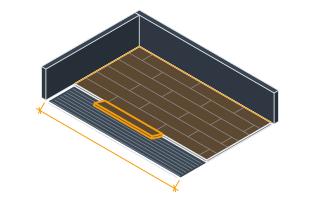
The net area taking primer, plinths and upstands included.
Measure what gets coated rather than the room. Plinths, upstands and the coved edge at the wall are all primed surface and all easy to leave out; equipment bases that stay in place come off it. On a floor with heavy detailing the difference runs to several per cent, which is more than the rounding on a kit.
The rate on the data sheet, which is measured on a smooth slab.
Published coverage is a laboratory figure taken on a steel-trowelled or otherwise smooth substrate. It is not wrong; it simply describes a surface nobody lays epoxy on, because every epoxy floor starts with the slab being opened up. That gap is what this page exists to close.
How rough the prepared slab is, on the scale a specification names.
ICRI publishes CSP 1 to 10 as moulded replicas you hold against the floor, and a specification names one of them. Each step up adds true surface area and open pore for the primer to disappear into. The factors behind these options are rules of thumb rather than published coefficients, which is why the first bay is the real measurement.
An addition for a dry, old or unusually porous slab, over and above the profile.
Profile and porosity are two different things: a freshly ground slab of dense, well-cured concrete has an open profile and little absorption, while an old, dry, lean slab drinks primer through its body regardless of how it was prepared. Leave this at zero unless the slab is visibly thirsty — a splash of water vanishing in seconds is the field test — and step it up rather than guessing high.
The mixed volume of one kit as your supplier sells it.
Enter the volume of resin and hardener TOGETHER, because that is what goes on the floor. Two-part primers cannot be split, so a kit is the real ordering unit and the rounding up at the end is not waste you can avoid — it is the smallest amount you are able to buy.
Primer needed
4.55 gal
The arithmetic is exact; the profile factor behind it is a rule of thumb rather than a published coefficient, because ICRI defines the surface profiles and attaches no coverage figure to any of them. Prime one bay, measure what it actually took, and order the rest on that.
- Kits to order
- 2 kits
- Effective coverage on this profile
- 142.86 ft²/gal
- What the data sheet rate alone would have ordered
- 3.25 gal
- Extra the profile and absorbency account for
- 1.3 gal
They open the calculator with your figures already in it
Epoxy Primer Coverage Over a Profiled Slab Calculator: 4.55 gal — shown in imperial, US market. The link sets both, so the result they see is the one on your screen.
Show calculation logicHide calculation logic
How this was calculated
Formula source(s)
- ICRI Guideline 310.2R, Selecting and Specifying Concrete Surface Preparation — defines concrete surface profiles CSP 1 to 10 as physical replicas of increasing roughness, and is how a specification names the profile this calculation asks for
- Effective coverage = published rate ÷ profile factor; volume = area ÷ effective rate × (1 + absorbency allowance). The profile factors offered here are rules of thumb, NOT published coefficients — ICRI defines the profiles and does not attach a coverage number to any of them
Inputs used
- Floor Area Being Primed
- 650 sq ft
- Published Coverage Rate for the Primer
- 200 ft²/gal
- Concrete Surface Profile (ICRI CSP)
- CSP 4–5 — an ordinary grind or medium shotblast
- Extra for a Thirsty Slab (%)
- 0
- Kit Size Supplied
- 2.75 gal
Intermediate steps
- Kits to order
- 2 kits
- Effective coverage on this profile
- 142.86 ft²/gal
- What the data sheet rate alone would have ordered
- 3.25 gal
- Extra the profile and absorbency account for
- 1.3 gal
Confidence note: The arithmetic is exact; the profile factor behind it is a rule of thumb rather than a published coefficient, because ICRI defines the surface profiles and attaches no coverage figure to any of them. Prime one bay, measure what it actually took, and order the rest on that.
What this calculation does not cover
- The profile factors are rules of thumb and the page says so in its own sources. They are the right shape — a rougher profile has more true surface and more open pore to fill — but the honest way to use them is to prime one bay, measure what it actually took, and re-order on that.
- It does not tell you which profile your specification needs. That follows from the coating system and its thickness, and it is in the manufacturer's literature.
- It assumes one coat. A slab that drinks the first coat to a matt finish needs a second, and that is a decision made on the floor rather than in advance.
- It says nothing about moisture. A primer ordered correctly and applied over a slab that is still giving up water fails anyway, and no coverage figure is a substitute for a moisture test.
Estimated cost — your price
This site holds no price list for this material — local prices vary too much to publish honestly. Enter your supplier's price and the result is costed with it.
Computed in your browser — nothing you enter is uploaded. Presented in US customary units and US trade terminology. Where a formula follows a published standard, that standard and its edition are cited beside it on this page; where none governs, the page says so. Local amendments override model codes — verify against the code in force where you build.
Sources checked 2026-09-20 · v1.0.0
Regulatory standards & verification citations2
- ICRI Guideline 310.2R, Selecting and Specifying Concrete Surface Preparation — defines concrete surface profiles CSP 1 to 10 as physical replicas of increasing roughness, and is how a specification names the profile this calculation asks for
- Effective coverage = published rate ÷ profile factor; volume = area ÷ effective rate × (1 + absorbency allowance). The profile factors offered here are rules of thumb, NOT published coefficients — ICRI defines the profiles and does not attach a coverage number to any of them
Cite this page
Your workspace
Most jobs need more than one number. Add the calculators you need next and they open right here, underneath this one — your figures stay on screen and nothing is lost to a page change.
Protection this work requires
- Stop and check first. Paint under later coats in older housing can be lead-based, and sanding or heat-stripping it produces lead dust that is especially harmful to children and to anyone pregnant. Test before you disturb it — this is a job for a tested, controlled method, not a better mask.
Tools and safety for this job
To roll and cut in two coats and prepare a surface for paint. Generic types, no brands, no prices.
- Joint-compound dust is very fine and travels: a P1/FFP1 mask is the minimum, and a damp-sponge finish avoids most of it.
- A dust mask does nothing about solvent vapour: ventilate through, and use an organic-vapour (A1) cartridge respirator in an enclosed room.
- Most fatal falls on small jobs are from under three metres: use a tower or a ladder tied at the top, and never work off the top two rungs.
Show the 11 tools this job needsHide tools
Essential
Brushes
Dust sheets and masking
Filling knife
Roller frame, sleeves and tray
Scraper
Recommended
Caulking gun
Extension pole
Pole sander
Random orbital sander
Step ladder
Optional
Dust extractor or vacuum with a fine filter
Also needed as materials: abrasive discs, caulk and sealant cartridges, masking tape, plastic sheeting, roller sleeves, sanding screens or paper.
what each painting tool is for, and the spec that decides which to buy where one does.