
SettingsSettings for this calculationUS
The standard allowance most suppliers and estimating guides assume for ordinary work.
The total roof area to be covered in clay barrel tile.
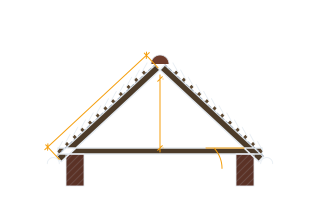
Measure the sloped roof surface area to be tiled, not the horizontal (plan view) footprint.
The net covered area contributed by one tile, accounting for overlap.
Check the manufacturer's coverage data for your specific tile profile and headlap — barrel tile coverage varies with tile size and the amount of overlap between courses.
Extra tile to allow for breakage, cuts, and hips/valleys.
Clay tile is brittle and has to be cut at every hip, valley and rake, so it carries a higher allowance than flat roofing. A plain gable with two clean rakes sits near the bottom of the range; a hipped roof broken up by dormers, with a cut on almost every course end, sits far above it. Take the figure from the roof geometry in front of you rather than from a default.
Clay barrel tiles needed
1,104 tiles
They open the calculator with your figures already in it
Clay Barrel Roof Tile Calculator: 1,104 tiles — shown in imperial, US market. The link sets both, so the result they see is the one on your screen.
Show calculation logicHide calculation logic
How this was calculated
Formula source(s)
- Tile count = ceil((roof area ÷ single tile coverage) × (1 + waste allowance)), the standard coverage method applied to clay barrel tile's typical per-unit coverage
Inputs used
- Roof Area
- 1080 sq ft
- Single Tile Coverage Area
- 1.08 sq ft
- Waste Allowance (%)
- 10
What this calculation does not cover
- Tiles are counted here, never weighed. Installed clay barrel tile runs roughly 9 to 12 lb (4 to 5.5 kg) per square foot for one-piece profiles and can approach 19 lb (8.5 kg) for two-piece, against about 2.5 lb (1.1 kg) for asphalt shingle, so whether the rafters and deck can carry the count this page produces is a framing check — re-covering a shingle roof in clay without one loads structure that was never sized for it.
- Order the whole roof, attic stock included, in one go. Clay is kiln-fired and shade varies noticeably between production runs, so tiles fetched later to cover a short count arrive visibly different and cannot be blended into a finished field — running short is a permanent patch on the roof, not just a delay.
Estimated cost — your price
This site holds no price list for this material — local prices vary too much to publish honestly. Enter your supplier's price and the result is costed with it.
Part of bigger jobs
This trade is one line of a job takeoff. Run the whole job and every other trade comes back with it, off the same measurements.
Or plan the space itself: measure it once, doors and windows included, and this figure comes back worked out on that space, with what goes with it.
also measures11 other trades
Computed in your browser — nothing you enter is uploaded. Presented in US customary units and US trade terminology. Where a formula follows a published standard, that standard and its edition are cited beside it on this page; where none governs, the page says so. Local amendments override model codes — verify against the code in force where you build.
Sources checked 2026-09-06 · in the site-wide review of 2026-09-06 · v1.0.1
Regulatory standards & verification citations1
- Tile count = ceil((roof area ÷ single tile coverage) × (1 + waste allowance)), the standard coverage method applied to clay barrel tile's typical per-unit coverage
Cite this page
Your workspace
Most jobs need more than one number. Add the calculators you need next and they open right here, underneath this one — your figures stay on screen and nothing is lost to a page change.
Tools and safety for this job
To batten and tile or slate the roof. Generic types, no brands, no prices.
Protection this work requires
- Cutting or grinding concrete, masonry, screed, tile or fibre-cement board releases respirable silica: cut wet or extract at the tool, and wear a P2/N95 respirator at minimum — a nuisance dust mask does not filter it.
- Saws, grinders and breakers run above 85 dB, where hearing damage accumulates and does not recover: defenders or plugs for every cut, not just the long ones.
- Breakers and grinders cause permanent nerve damage: limit continuous trigger time, keep hands warm, and stop if fingers tingle or blanch.
- Boards, blocks and bagged material cause most lasting back injuries on small sites: two people or a lifter for full sheets, and never a bag on one shoulder up a ladder.
- Most fatal falls on small jobs are from under three metres: use a tower or a ladder tied at the top, and never work off the top two rungs.
Show the 5 tools this job needsHide tools
Essential
Chalk line
Claw hammer
Hand saw
Tape measure
Recommended
Angle grinder
Also needed as materials: chalk refill, cutting and diamond discs.
what each roofing tool is for, and the spec that decides which to buy where one does.