
SettingsSettings for this calculationUS
Four straight walls by their two sides, or the total run of papered wall round any other room.
Paper is hung in drops side by side, so what decides the rolls is how far the papered walls run and how tall they are. A room with an alcove, a bay or a chimney breast is easiest taken wall by wall at skirting height, every return included, and added up into one run.
The length of the room to be papered.
Measure along the floor from one wall to the opposite wall.
Tools needed: Tape measure
The width of the room to be papered.
Measure perpendicular to the length.
Tools needed: Tape measure
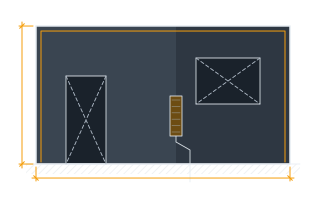
Floor-to-ceiling height.
Standard residential ceilings are commonly 2.4 m (8 ft).
Tools needed: Tape measure
Count US double rolls by area, as this page always has, or count any roll by the strips it gives.
The double-roll count divides the wall area, with a waste allowance for the pattern, by the 56 sq ft (5.2 m²) a US double roll covers. The drops count works the way rolls are hung: it asks for the roll's own length and width, cuts each drop to the wall height plus a trim allowance and up to a whole pattern repeat, and counts how many whole drops each roll gives. Use drops for a UK or European roll, commonly 10.05 m (33 ft) long and 0.53 m (20.9 in) wide, for a wide roll, or for any paper whose label gives its size. For Australia no separate standard roll size was found, so read the size on the label.
Larger pattern repeats waste more material matching strips together.
Check the product label for the pattern repeat distance — anything over about 18 in (46 cm) counts as a large repeat.
Estimated wallpaper needed
9 double rolls
- Wall area
- 392 sq ft
- Waste factor applied
- 15 %
- Area with waste
- 450.8 sq ft
They open the calculator with your figures already in it
Wallpaper Calculator: 9 double rolls — shown in imperial, US market. The link sets both, so the result they see is the one on your screen.
Show calculation logicHide calculation logic
How this was calculated
Formula source(s)
- US double rolls: the page divides the wall area, with the pattern-match waste added, by 56 sq ft a double roll (York Wallcoverings lists a 20.5 in × 33 ft double roll as covering about 56.4 sq ft)
- 10% waste is standard; large pattern repeats or diagonal cuts can push waste to 20-25%
- A.S. Création Tapeten AG, Thermo-Wall technical data sheet (December 2022): rolls of 10.05 m × 0.53 m (Euro roll) and 10.05 m × 1.06 m (wide roll), dimensional tolerances to DIN EN 233, the European specification for finished wallpapers
- A.S. Création, roll calculator guidance: standard roll formats are Euro rolls of 10.05 m × 0.53 m; the room perimeter and height decide the rolls; add about 5 cm to the room height to avoid a tight cut; plan a spare roll for later repairs
- York Wallcoverings, product data and roll calculator (read 2026-10-05): a double roll of 20.5 in × 33 ft covering about 56.4 sq ft, another of 27 in × 27 ft covering about 60.8 sq ft; the calculator takes the strip as the wall height rounded up to whole pattern repeats, the strips as the wall width over the roll width rounded up, less one whole strip for each roll width an opening spans, and the rolls as the strips over the whole strips a roll gives, the roll length over the strip rounded down; it takes no match type. This page departs from it in three places: it adds the makers' trim before rounding, it takes nothing off for openings, and it lets the last drop on a roll stop at the wall height and the trim rather than at a whole strip
- York Wallcoverings installation guide: measure the wall height and allow approximately 4 in of additional length, about 2 in at the ceiling and 2 in at the baseboard, for trimming, accounting for the pattern repeat and match
- Meinewand, calculating wallpaper with a repeat: strips needed are the wall width over the roll width; the panel length is the number of repeats that cover the room height times the repeat; one roll gives the roll length over the panel length (2.65 m room, 0.72 m repeat, 10.05 × 0.53 m roll: 4 repeats, 2.88 m panels, 3 a roll)
- Farrow & Ball, calculating wallpaper quantities: every roll 10 m long and 53 cm wide; in a standard 2.4 m high room, three drops a roll for small pattern repeats and four for striped papers
- Cole & Son hanging instructions and Graham & Brown's wallpaper FAQs: a random or free match has nothing to line up at the joining edge; a straight match joins in the same place on the next drop; a half-drop or offset match drops half a repeat from side to side and repeats at the ceiling line on every other strip
- Graham & Brown, how to hang wallpaper: a roll is 52 to 53 cm wide; allow a little extra, for example 2 to 3 cm at the top, and trim in line with the ceiling
Inputs used
- Walls Measured As
- A rectangle (length and width)
- Measured Wall Run
- 49 ft
- Room Length
- 13 ft
- Room Width
- 11.5 ft
- Wall Height
- 8 ft
- Roll, and How It Is Counted
- US double roll, counted by wall area at 56 sq ft (5.2 m²) a roll
- Pattern Match
- Small repeat (15% waste)
- Roll Length
- 33 ft
- Roll Width
- 20.5 in
- Match Type
- Straight match
- Pattern Repeat
- 21 in
- Trim Allowance on Each Drop
- 4 in
Intermediate steps
- Wall area
- 392 sq ft
- Waste factor applied
- 15 %
- Area with waste
- 450.8 sq ft
What this calculation does not cover
- The wall area is a single perimeter-times-height rectangle, so chimney breasts, alcoves, bay returns and sloped or gabled walls are never measured and have to be totalled wall run by wall run instead.
- Waste is one of three fixed multipliers picked from the Pattern Match menu, and the repeat distance printed on the roll, whether the paper is a straight or a drop match, and how many full drops each roll actually yields never enter the arithmetic; the drops count does use them.
- Roll count comes from dividing the padded area by a flat 56 sq ft (5.2 m²) a roll, which assumes a roll is used down to its last square foot — in practice the tail of a roll too short for one more floor-to-ceiling drop is dead stock, and the taller the wall the more of that there is in every roll.
- The answer is counted in US double rolls even when the room is measured in metres rather than in feet; for a UK, European or Australian roll, or anything sold to another size, choose the drops count and enter the size on the label.
- Only the four walls are included: papering the ceiling, running a border or frieze, and any lining paper hung underneath are separate orders this figure does not cover.
Estimated cost — your price
This site holds no price list for this material — local prices vary too much to publish honestly. Enter your supplier's price and the result is costed with it.
Part of a bigger job
Or plan the space itself: measure it once, doors and windows included, and this figure comes back worked out on that space, with what goes with it.
Computed in your browser — nothing you enter is uploaded. Presented in US customary units and US trade terminology. Where a formula follows a published standard, that standard and its edition are cited beside it on this page; where none governs, the page says so. Local amendments override model codes — verify against the code in force where you build.
Sources checked 2026-10-05 · v1.2.0
Regulatory standards & verification citations10
- US double rolls: the page divides the wall area, with the pattern-match waste added, by 56 sq ft a double roll (York Wallcoverings lists a 20.5 in × 33 ft double roll as covering about 56.4 sq ft)
- 10% waste is standard; large pattern repeats or diagonal cuts can push waste to 20-25%
- A.S. Création Tapeten AG, Thermo-Wall technical data sheet (December 2022): rolls of 10.05 m × 0.53 m (Euro roll) and 10.05 m × 1.06 m (wide roll), dimensional tolerances to DIN EN 233, the European specification for finished wallpapers
- A.S. Création, roll calculator guidance: standard roll formats are Euro rolls of 10.05 m × 0.53 m; the room perimeter and height decide the rolls; add about 5 cm to the room height to avoid a tight cut; plan a spare roll for later repairs
- York Wallcoverings, product data and roll calculator (read 2026-10-05): a double roll of 20.5 in × 33 ft covering about 56.4 sq ft, another of 27 in × 27 ft covering about 60.8 sq ft; the calculator takes the strip as the wall height rounded up to whole pattern repeats, the strips as the wall width over the roll width rounded up, less one whole strip for each roll width an opening spans, and the rolls as the strips over the whole strips a roll gives, the roll length over the strip rounded down; it takes no match type. This page departs from it in three places: it adds the makers' trim before rounding, it takes nothing off for openings, and it lets the last drop on a roll stop at the wall height and the trim rather than at a whole strip
- York Wallcoverings installation guide: measure the wall height and allow approximately 4 in of additional length, about 2 in at the ceiling and 2 in at the baseboard, for trimming, accounting for the pattern repeat and match
- Meinewand, calculating wallpaper with a repeat: strips needed are the wall width over the roll width; the panel length is the number of repeats that cover the room height times the repeat; one roll gives the roll length over the panel length (2.65 m room, 0.72 m repeat, 10.05 × 0.53 m roll: 4 repeats, 2.88 m panels, 3 a roll)
- Farrow & Ball, calculating wallpaper quantities: every roll 10 m long and 53 cm wide; in a standard 2.4 m high room, three drops a roll for small pattern repeats and four for striped papers
- Cole & Son hanging instructions and Graham & Brown's wallpaper FAQs: a random or free match has nothing to line up at the joining edge; a straight match joins in the same place on the next drop; a half-drop or offset match drops half a repeat from side to side and repeats at the ceiling line on every other strip
- Graham & Brown, how to hang wallpaper: a roll is 52 to 53 cm wide; allow a little extra, for example 2 to 3 cm at the top, and trim in line with the ceiling
Cite this page
Your workspace
Most jobs need more than one number. Add the calculators you need next and they open right here, underneath this one — your figures stay on screen and nothing is lost to a page change.