
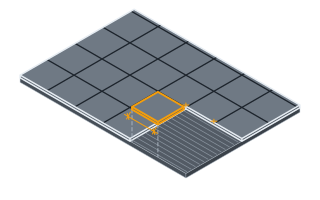
SettingsSettings for this calculationUS
The standard allowance most suppliers and estimating guides assume for ordinary work.
The tiled area — the surface, not the tiles ordered.
Use the area of the floor or wall being tiled. Cutting waste raises the tile order and not the grout: an offcut set into an edge has the same joints around it as the whole tile it replaced.
The long side of one tile, as sold.
Use the tile's actual size from the box, not its nominal name: a tile sold as 12 × 12 in is often 11.8 in, and at small sizes the difference is a noticeable share of the joint. For a mosaic on a sheet, enter the size of one piece, not of the sheet.
The short side of one tile; the same as the length for a square tile.
A plank tile of 1200 × 200 mm (about 48 × 8 in) has more joint per square metre than a 600 mm (24 in) square covering the same floor, because its long, narrow shape puts a joint close to every point on the floor.
The gap between tiles — the spacer size.
Rectified porcelain is often laid at 2 mm (about 1/16 in), ordinary floor tile at 3 to 5 mm (1/8 to 3/16 in), and handmade or rustic tile wider. Grout is in proportion to the joint width, so going from 2 mm to 5 mm more than doubles the grout for the same tiles.
How deep the grout goes — normally the tile's thickness.
A joint is filled flush from the adhesive bed to the tile face, so its depth is the tile thickness less any adhesive squeezed up into it. Clean the joints out to the full depth before grouting: a joint half full of set adhesive takes half the grout and cracks.
The weight of one volume of grout once mixed and packed into the joint.
1,600 kg/m³ (about 100 lb per cubic foot) is the figure cement-based grout packaging formulas commonly use; a sanded or epoxy grout can be heavier. Where the bag gives a consumption formula with its own density, use that figure.
Grout left in the bucket, on the float and washed off the face.
Grout is mixed in batches with a working time, and some is always wiped off the tile face and lost. Ten per cent is normal; raise it for wide joints on textured tile, where more is pressed in and taken off again.
Grout needed
3.051 lb
About 1 × 25 lb bag(s). The joint volume is geometry and is as good as the sizes entered; the mass follows the density, which varies by product.
- Share of the surface that is joint
- 0.98 %
- Joint volume
- 0.03 ft³
- Before the allowance
- 2.77 lb
- Allowance at 10%
- 0.28 lb
- 25 lb bags
- 1 bag
They open the calculator with your figures already in it
Grout Calculator: 3.05 lb — shown in imperial, US market. The link sets both, so the result they see is the one on your screen.
Show calculation logicHide calculation logic
How this was calculated
Formula source(s)
- Derived rather than tabulated: tiles on a grid form modules of (length + joint) × (width + joint), so the share of the surface that is joint is 1 − length × width ÷ ((length + joint)(width + joint)); joint volume is that share × area × joint depth, and mass is volume × the mixed grout's density
- The consumption formula printed on cementitious grout packaging, (length + width) ÷ (length × width) × joint width × joint depth × density, is the same geometry without the joint-crossing correction and reads within 2% of it at common tile sizes
Inputs used
- Area to grout
- 110 sq ft
- Tile length
- 24 in
- Tile width
- 24 in
- Joint width
- 0.12 in
- Joint depth
- 0.31 in
- Grout density (mixed)
- 99.88 pcf
- Waste allowance
- 10
Intermediate steps
- Share of the surface that is joint
- 0.98 %
- Joint volume
- 0.03 ft³
- Before the allowance
- 2.77 lb
- Allowance at 10%
- 0.28 lb
- 25 lb bags
- 1 bag
Confidence note: About 1 × 25 lb bag(s). The joint volume is geometry and is as good as the sizes entered; the mass follows the density, which varies by product.
What this calculation does not cover
- The joints are counted on a straight grid. A herringbone, a brick bond or a mix of tile sizes lays the same joint area only approximately, and an irregular stone or hexagonal tile has a different joint geometry altogether.
- Joint depth is taken as full to the tile face. Where adhesive has squeezed up into the joints and set, the grout goes less deep and less is used — and the joint is weaker for it.
- Movement joints take a flexible sealant, not grout — at internal corners, where tiling meets a bath or shower tray, round the edges, and at intervals across a large floor — and grout put into them cracks. They are counted here as grout, so on a room with many of them the figure reads slightly high.
- Density varies by product, and a sanded or epoxy grout can be heavier than the default. A bag's own consumption chart, where it gives one, is the better figure for that product.
Estimated cost — your price
This site holds no price list for this material — local prices vary too much to publish honestly. Enter your supplier's price and the result is costed with it.
Part of bigger jobs
This trade is one line of several job takeoffs. Run the whole job and every other trade comes back with it, off the same measurements.
Or plan the space itself: measure it once, doors and windows included, and this figure comes back worked out on that space, with what goes with it.
also measures11 other trades
also measures24 other trades
Computed in your browser — nothing you enter is uploaded. Presented in US customary units and US trade terminology. Where a formula follows a published standard, that standard and its edition are cited beside it on this page; where none governs, the page says so. Local amendments override model codes — verify against the code in force where you build.
Sources checked 2026-09-17 · v1.0.0
Regulatory standards & verification citations2
- Derived rather than tabulated: tiles on a grid form modules of (length + joint) × (width + joint), so the share of the surface that is joint is 1 − length × width ÷ ((length + joint)(width + joint)); joint volume is that share × area × joint depth, and mass is volume × the mixed grout's density
- The consumption formula printed on cementitious grout packaging, (length + width) ÷ (length × width) × joint width × joint depth × density, is the same geometry without the joint-crossing correction and reads within 2% of it at common tile sizes
Cite this page
Your workspace
Most jobs need more than one number. Add the calculators you need next and they open right here, underneath this one — your figures stay on screen and nothing is lost to a page change.
Tools and safety for this job
To grout and seal tiling. Generic types, no brands, no prices.
Protection this work requires
- Wet cement and lime burn skin and eyes painlessly until the damage is done: waterproof gloves to EN 374, safety glasses whenever the mix can splash, and never kneel in wet mix in permeable trousers.
Show the 3 tools this job needsHide tools
Essential
Grout float and sponge
Mixing bucket or tub
Recommended
Caulking gun
Also needed as materials: caulk and sealant cartridges, grout sponges.
what each tiling tool is for, and the spec that decides which to buy where one does.