
SettingsSettings for this calculationUS
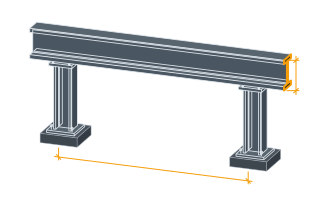
The horizontal distance across the braced bay.
Node to node — the working points the brace runs between, which are the intersections of the member centrelines rather than the clear opening or the face of the columns. A rod cut to the clear dimension is short by the depth of the connections at both ends, and a tension rod that does not reach is not adjustable in the direction you need.
The vertical distance across the braced bay.
Node to node vertically, floor beam centreline to floor beam centreline in most frames. With the horizontal dimension this fixes the brace's length and its angle, and the angle matters as much as the length: a brace much steeper or flatter than roughly 45 degrees carries a poor share of the horizontal force for the tension it develops, and the rod gets large to compensate.
The linear weight of the rod or cable, from its diameter/section table.
Look this up from the manufacturer's or standard section table for the specific rod or cable diameter — it is not derived from the span and height entered above.
Bracing rod weight
60.6 lb
- Diagonal length
- 23.44 ft · 23 ft 5 1/4 in
They open the calculator with your figures already in it
Steel Bracing Rod Diagonal Length & Weight Calculator: 60.63 lb — shown in imperial, US market. The link sets both, so the result they see is the one on your screen.
Show calculation logicHide calculation logic
How this was calculated
Formula source(s)
- Diagonal bracing length = √(horizontal span² + vertical height²), standard right-triangle geometry; weight = length × the rod's linear weight (from its diameter/section table)
Inputs used
- Horizontal Span
- 19.5 ft
- Vertical Height
- 13 ft
- Rod/Cable Weight per Meter
- 2.59 lb/ft
Intermediate steps
- Diagonal length
- 23.44 ft
What this calculation does not cover
- The diagonal is measured corner to corner of the bay, which is the work line and not a cut length. A rod brace is an assembly — threaded ends, a turnbuckle or coupler, clevises or pins — and that hardware commonly takes 300 to 600 mm (24 in) out of the run, so the rod ordered is shorter than the figure here while the installed assembly is exactly this long. Cut the rod to the diagonal and there is no thread left to tension it.
- One rod is counted. Rods and cables carry tension only and go slack the instant the load reverses, so a braced bay is normally cross-braced with a pair working in opposite directions, and a frame braced in two directions doubles again. Take this weight straight into a bill of materials and the brace steel comes in at half.
Estimated cost — your price
This site holds no price list for this material — local prices vary too much to publish honestly. Enter your supplier's price and the result is costed with it.
Computed in your browser — nothing you enter is uploaded. Presented in US customary units and US trade terminology. Where a formula follows a published standard, that standard and its edition are cited beside it on this page; where none governs, the page says so. Local amendments override model codes — verify against the code in force where you build.
Sources checked 2026-09-06 · 2 test vectors · in the site-wide review of 2026-09-06 · v1.1.1
Regulatory standards & verification citations1
- Diagonal bracing length = √(horizontal span² + vertical height²), standard right-triangle geometry; weight = length × the rod's linear weight (from its diameter/section table)
Cite this page
Your workspace
Most jobs need more than one number. Add the calculators you need next and they open right here, underneath this one — your figures stay on screen and nothing is lost to a page change.