
SettingsSettings for this calculationUS
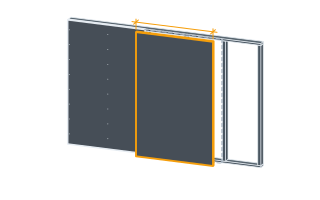
The wall or ceiling area receiving the laminated second layer of drywall.
Use the same area as the face layer being bonded — the laminating adhesive is spread across this entire surface before the second sheet is set.
The adhesive's published spread rate — mass applied per unit of area.
Take this from the adhesive manufacturer's technical data sheet — spread rate depends on the product and the application method (notched trowel, dabs, or bead pattern).
Laminating adhesive needed
44 lb
Spread rate varies by adhesive product and application method (trowel notch size, dab pattern) — use your specific adhesive's technical data sheet for the rated coverage.
They open the calculator with your figures already in it
Double-Layer Drywall Lamination Adhesive Calculator: 44.04 lb — shown in imperial, US market. The link sets both, so the result they see is the one on your screen.
Show calculation logicHide calculation logic
How this was calculated
Formula source(s)
- Laminating adhesive mass = wall/ceiling area × the adhesive's published spread rate (kg per m²)
Inputs used
- Area to Laminate
- 430 sq ft
- Adhesive Spread Rate
- 0.1 lb/sq ft
Confidence note: Spread rate varies by adhesive product and application method (trowel notch size, dab pattern) — use your specific adhesive's technical data sheet for the rated coverage.
What this calculation does not cover
- Adhesive has a clock on it that the spread rate does not carry. A quantity per unit area contains no time, but laminating compound skins over in minutes, and a sheet pressed onto adhesive that has already stiffened is a sheet that lets go of the wall later. The area you can wet out before the board goes up is what breaks the work into bays, and heat, wind or a dry warm interior shortens it further.
- The bond is only as good as the face it lands on, and this assumes a perfect one. Laminating compound grips the base layer's paper; over a painted, dusty, damp or vinyl-faced base layer it grips the coating instead, and the joint later fails in that skin rather than in the adhesive. Those areas need the face cut back to clean paper or the second layer screwed through to framing, and neither of those changes the mass this returns.
Estimated cost — your price
This site holds no price list for this material — local prices vary too much to publish honestly. Enter your supplier's price and the result is costed with it.
Computed in your browser — nothing you enter is uploaded. Presented in US customary units and US trade terminology. Where a formula follows a published standard, that standard and its edition are cited beside it on this page; where none governs, the page says so. Local amendments override model codes — verify against the code in force where you build.
Sources checked 2026-09-06 · in the site-wide review of 2026-09-06 · v1.1.1
Regulatory standards & verification citations1
- Laminating adhesive mass = wall/ceiling area × the adhesive's published spread rate (kg per m²)
Cite this page
Your workspace
Most jobs need more than one number. Add the calculators you need next and they open right here, underneath this one — your figures stay on screen and nothing is lost to a page change.
Tools and safety for this job
To hang plasterboard and cut board around openings and boxes. Generic types, no brands, no prices.
Protection this work requires
- Joint-compound dust is very fine and travels: a P1/FFP1 mask is the minimum, and a damp-sponge finish avoids most of it.
- Boards, blocks and bagged material cause most lasting back injuries on small sites: two people or a lifter for full sheets, and never a bag on one shoulder up a ladder.
- Knives cause more site injuries than any power tool: cut away from your body, change blades often, and wear cut-resistant gloves to EN 388 level C for repeated cutting.
Show the 9 tools this job needsHide tools
Essential
Cordless drill/driver
Drywall saw
Tape measure
Utility knife
Recommended
Board lifter
Combination or framing square
Drywall screw gun
Optional
Oscillating multi-tool
Panel lift
Also needed as materials: drill and driver bits, oscillating blades, replacement blades.
what each drywall tool is for, and the spec that decides which to buy where one does.