
SettingsSettings for this calculationUS
The standard allowance most suppliers and estimating guides assume for ordinary work.
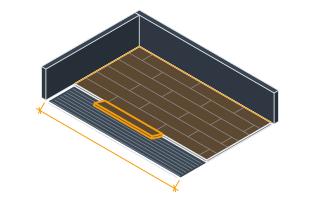
Add up every seam on the drawing, including the short ones at doorways.
This comes off the seam plan rather than out of a formula, because seam placement is a judgement about traffic, light and where the drops fall — not something a room's dimensions determine. Cross seams and short returns count in full; they use tape at the same rate as a long run and are the ones people forget.
How much hot-melt tape is on one roll as supplied.
Tape is bought by the roll and there is no partial roll, so this figure decides the rounding rather than the quantity. Check the width as well while you are reading the label: a wider tape suits an open-backed carpet and a heavier traffic class, and it is not interchangeable with the narrow domestic grade.
Extra tape for overrunning each seam end and for the odd re-cut.
Tape is run slightly past both ends of a seam so the iron reaches full temperature on material rather than on the floor, and a seam that has to be opened and remade consumes its tape twice. Ten percent covers a straightforward plan; raise it where the plan has many short seams, because the overrun is per seam and not per metre.
How far one tube of latex seam sealer runs, from its own label.
Coverage differs sharply between products and between applicator tips, and the bead has to be heavy enough to wet the backing rather than merely sit on it. Take the figure from the tube you are actually buying; the default here is a placeholder to be replaced, not a specification.
Seam tape rolls required
2 rolls
- Latex seam sealer tubes
- 2 tubes
- Tape to be laid, allowance included
- 170.5 ft
- Tape left on the last roll
- 29.5 ft
They open the calculator with your figures already in it
Carpet Seam Tape and Sealer Calculator: 2 rolls — shown in imperial, US market. The link sets both, so the result they see is the one on your screen.
Show calculation logicHide calculation logic
How this was calculated
Formula source(s)
- CRI 104, Standard for Installation of Commercial Carpet, and CRI 105, Standard for Installation of Residential Carpet — the standards covering seam construction, hot-melt seaming and the sealing of cut edges
- BS 5325, Installation of textile floor coverings — Code of practice — the equivalent UK guidance on seaming and edge treatment
- Rolls = ceil(seam length × (1 + waste) ÷ tape roll length); sealer tubes = ceil(the same length ÷ the sealer's own stated coverage per tube).
Inputs used
- Total Seam Length from the Plan
- 155 ft
- Tape Roll Length
- 100 ft
- Waste Allowance (%)
- 10
- Sealer Coverage per Tube
- 98 ft
Intermediate steps
- Latex seam sealer tubes
- 2 tubes
- Tape to be laid, allowance included
- 170.5 ft
- Tape left on the last roll
- 29.5 ft
What this calculation does not cover
- Seaming irons, tape shields, tractors and the power stretcher are plant, not consumables, and are not counted.
- A glue-down or double-stick installation seams differently and uses adhesive rather than hot-melt tape.
Estimated cost — your price
This site holds no price list for this material — local prices vary too much to publish honestly. Enter your supplier's price and the result is costed with it.
Part of a bigger job
This trade is one line of a job takeoff. Run the whole job and every other trade comes back with it, off the same measurements.
also measuresCarpet Roll Length & WasteCarpet Cushion Roll
Computed in your browser — nothing you enter is uploaded. Presented in US customary units and US trade terminology. Where a formula follows a published standard, that standard and its edition are cited beside it on this page; where none governs, the page says so. Local amendments override model codes — verify against the code in force where you build.
Sources checked 2026-09-02 · in the site-wide review of 2026-09-06 · v1.0.1
Regulatory standards & verification citations3
- CRI 104, Standard for Installation of Commercial Carpet, and CRI 105, Standard for Installation of Residential Carpet — the standards covering seam construction, hot-melt seaming and the sealing of cut edges
- BS 5325, Installation of textile floor coverings — Code of practice — the equivalent UK guidance on seaming and edge treatment
- Rolls = ceil(seam length × (1 + waste) ÷ tape roll length); sealer tubes = ceil(the same length ÷ the sealer's own stated coverage per tube).
Cite this page
Your workspace
Most jobs need more than one number. Add the calculators you need next and they open right here, underneath this one — your figures stay on screen and nothing is lost to a page change.
Tools and safety for this job
To lay carpet. Generic types, no brands, no prices.
Protection this work requires
- Boards, blocks and bagged material cause most lasting back injuries on small sites: two people or a lifter for full sheets, and never a bag on one shoulder up a ladder.
- Knives cause more site injuries than any power tool: cut away from your body, change blades often, and wear cut-resistant gloves to EN 388 level C for repeated cutting.
Show the 5 tools this job needsHide tools
Essential
Carpet trimmer and tucking tool
Knee kicker and carpet stretcher
Tape measure
Utility knife
Recommended
Claw hammer
Also needed as materials: replacement blades.
what each flooring tool is for, and the spec that decides which to buy where one does.