
How the two differ in kind
Heat gets into a house through the attic by more than one route, and the two products argue about different ones. Loose fill on the attic floor is a conduction answer: a thick, still, low-conductivity layer that slows heat crossing the ceiling plane, described by an R-value that stacks with depth and works in whichever direction the temperature difference points. A radiant barrier is a radiation answer: a low-emittance foil facing an air space, put in the way of the exchange between a sun-baked roof deck and everything below it. On a hot afternoon the underside of that deck sits well above the air touching it and radiates downward for hours, and a large share of what eventually reaches the ceiling arrives that way rather than by contact. R-value is not the quantity that describes the foil — emittance is — and the number only exists while the reflective face has an air gap in front of it. So the honest framing is not which of the two is better insulation. It is which of two different jobs is currently the unfinished one above your ceiling.
The variable that decides most cases is the settled depth already on the attic floor, and it decides in a way that is easy to feel but easy to get backwards. Heat flow across the ceiling falls with the reciprocal of the total resistance, which means the first depth added over a thin floor is worth several times the last depth added to a deep one. Where the floor is shallow, depth wins almost regardless of climate: it is the larger effect, it requires no assumptions about how much sun the roof takes, and it works in January as well as July. Where the floor is already at the depth the local target calls for, more depth is buying a thin slice off a number that is already small — and that is precisely the condition under which the barrier's argument becomes strong. The trap is treating the two as independent. They are not. A barrier's measured benefit is largest over a thin floor and shrinks as that floor deepens, because deep loose fill is already resisting most of what the foil would have deflected. Adding depth erodes the barrier's payoff; adding the barrier barely changes depth's. Anyone intending to do both eventually should notice that this makes the order a real decision rather than a preference.
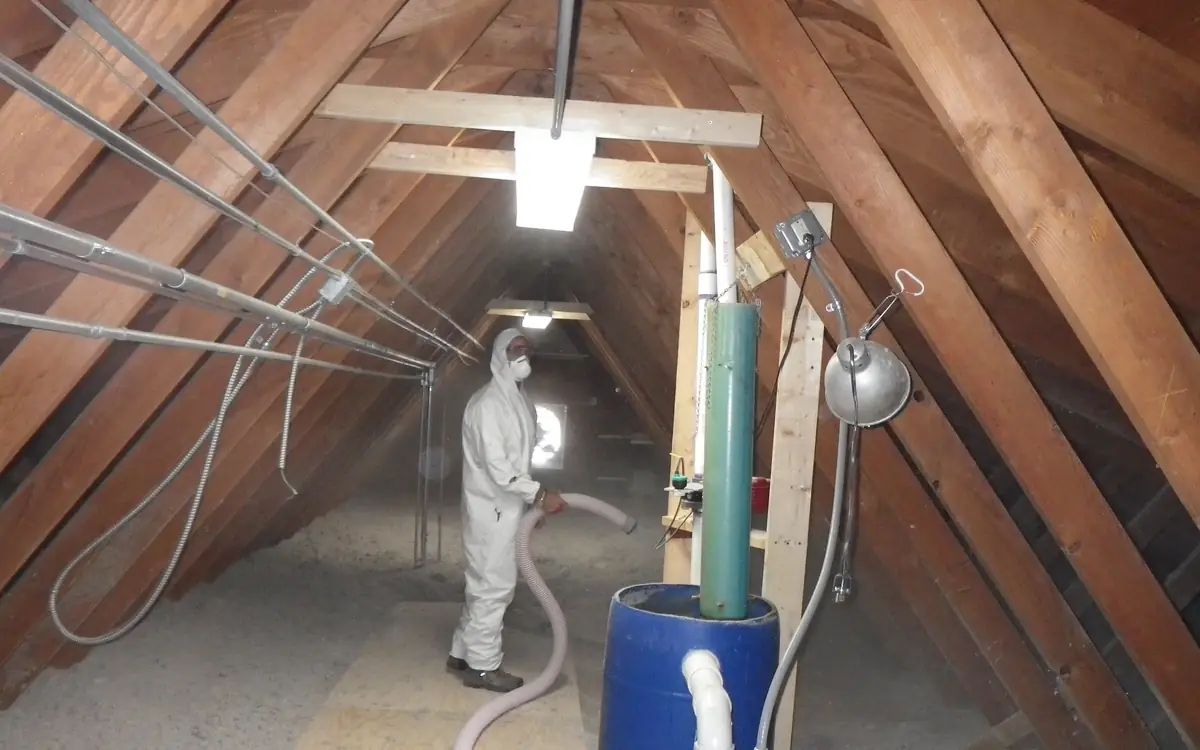
What else lives in the attic is the second decider, and the only one that can flip the answer without reference to depth at all. If the ducts and the air handler are up there, they are sitting in the hottest air in the building, and the barrier is the one of the two measures that changes that air's temperature and the surface temperature of the ducts inside it. Floor insulation sits underneath the ducts and does nothing for them. The same logic covers an attic used for storage or a room built into the roof. Then the practical shapes differ, and they differ in ways that show up on the invoice without anyone needing to invent a figure. The barrier is a labour problem counted in rafter bays: overhead work, in the hottest space in the house, cutting around bracing and wiring, and its quantity is an area — the sloped roof plane, which is always larger than the ceiling beneath it and grows as the pitch steepens. Blown-in is a material and machine problem: once the hose is running the crew time barely changes with area, while the quantity is a volume, area multiplied by depth, with depth as a dial you can set anywhere. Five questions settle nearly every real case. How deep is the settled fill on the floor right now. Are the ducts in the attic. How much sun does that roof plane genuinely take once shading and orientation are honest. Is there headroom to work overhead in the rafter space. And has the ceiling plane ever been air sealed.
The factors that actually differ
| Attic radiant barrier | Blown-in insulation | |
|---|---|---|
| The heat it acts on | Radiation only. A low-emittance face intercepts the exchange between a hot deck and the surfaces below it, and adds essentially no resistance to heat travelling by contact. Its rated performance exists only while that face has an air space in front of it. | Conduction. A thick still layer resisting heat crossing the ceiling plane, described by an R-value that stacks with depth and does nothing about what the deck is radiating overhead. |
| The season it earns in | Cooling season, near enough exclusively. Winter heat loss is a conduction and air-leakage problem the foil is not built to touch, which is why the case for it lives or dies on how hot and how sunny the year is. | Both directions, all year. The same depth that keeps July out keeps January in, so its value survives a mild summer and a change of climate assumptions. |
| What the quantity is measured against | An area, and the larger of the two: the sloped roof plane, plus gable ends where they are lined, plus laps. It grows with the pitch, so a steep roof buys more foil than the ceiling below it would suggest. | A volume: the flat ceiling area multiplied by the target depth. Two dimensions are fixed by the house and the third is chosen, which is why the bag count moves with the depth decision more than with the attic. |
| Whether performance has a dial | Coarse at best. There is one thickness of the thing and a bay is either lined or it is not, so the only way to buy less is to line fewer planes — a judgement about which slopes actually take the sun, not a performance level you can set. | Continuous. Depth can be set to any target the coverage chart supports, part of the job can be deferred, and the layer can be topped up later without disturbing what is there. |
| Ducts and anything else in the attic | Lowers the temperature of the air the ducts, the air handler and any stored contents sit in — the one benefit on this page that floor insulation cannot deliver at any depth. | Sits beneath the ducts and does nothing for them. Deep fill can make a leaky attic duct run worse in relative terms, because the ceiling below is now the well-defended surface and the ductwork is not. |
| Where the returns run out | Against a deep, well-covered attic floor, because that floor is already resisting most of what the foil would have deflected. Its case is strongest exactly where the insulation case is weakest. | Against its own previous depth. Resistance stacks linearly but heat flow falls with its reciprocal, so the first added depth over a thin floor is worth several times the last added to a deep one. |
| Shape of the labour | Labour-dominated and counted in rafter bays. Overhead stapling in the hottest space in the house, hand-cut around bracing, wiring and hips, with no machine that makes a large roof go faster than a small one. | Material-and-machine dominated. Hopper, hose and hatch protection are a fixed block of effort whatever the attic size, and past that a machine places the material instead of a pair of hands working overhead — so what grows with the job is the bag count more than the difficulty. |
| What it buries | Nothing. The ceiling plane stays visible and reachable, so air sealing, wiring and downlight work can happen before or after in either order. | The ceiling plane, permanently as far as convenience goes. Air sealing, junction boxes, baffles and downlight clearances have to be finished before the hose starts, or dug back out afterwards. |
| How it ages, and what spoils it | Emittance is a property of the top few microns of the surface, so dust and contact are the enemies — an upward-facing foil collecting attic dust, or a face pressed against something instead of an air gap, is no longer the material that was tested. | Settles, and that is already in the arithmetic: the coverage chart's initial installed depth is set so the layer arrives at its rated resistance after settling. What actually spoils it is later foot traffic compressing tracks through it. |
Which one, and when
Choose attic radiant barrier when…
- The attic floor is already at or close to the depth your local target calls for, so the next added depth is buying a thin slice off an already-small number.
- The ducts or the air handler are in the attic. Nothing you do to the floor helps them, and this is the measure that lowers the temperature of the air they sit in.
- The climate is genuinely cooling-dominated and the roof plane genuinely takes the sun — a large unshaded area, a dark covering, real western or southern exposure rather than a hopeful assumption.
- There is headroom and clear rafter bays to work in, which is the difference between an awkward job and an impossible one.
- You intend to do both, and this is the one that has to go first — stapling foil overhead is far worse once there is deep loose fill on the floor to wade through and compress.
Choose blown-in insulation when…
- The settled depth on the floor is short of the target. This is the case where depth wins outright, and it wins in both seasons without needing any assumption about sun to hold.
- What is up there now is uneven, compressed or patchy old material, where the gain is as much about making the layer continuous as about making it thicker.
- There is no headroom to work overhead, or the roof structure is a forest of bracing and hips — blown fill reaches from the hatch into places a person cannot go.
- Winter is not negligible even if summer dominates, and you want the spend to work in both directions rather than one.
- You want the option to buy in stages: set the depth you can afford now, top it up later, and let the coverage chart rather than the roof decide the quantity.
Now run your own numbers
This page holds no prices on purpose — a national average is wrong for almost every real project. Quantify both options with your dimensions and your local quotes.
Frequently asked questions
- Which one is cheaper?
- They are shaped so differently that a single answer would be a fiction, which is why this site refuses a figure. The barrier is labour-dominated: an overhead job counted in rafter bays, in the hottest space in the house, with no machine that makes a big roof faster than a small one — and its material is bought against the sloped roof plane, an area larger than the ceiling below it and growing with the pitch. Blown-in inverts that: a fixed block of the labour is setup, and past that a machine is placing the material rather than a pair of hands working overhead, while the quantity is a volume and the depth dial moves it directly. That also means the two respond differently to a bigger house. A bigger ceiling raises the foil area and the bag count together, but it also raises the hours somebody spends stapling overhead, whereas the blowing job absorbs part of the increase into a setup that happens once however large the attic. Run the roll count and the bag count against your own dimensions and your own quotes, and price both jobs the same week.
- Do I actually have to choose — can I do both?
- Yes, and in a hot climate with a shallow attic floor both are usually defensible; they resist different mechanisms, so they are only alternatives inside a budget, not in physics. What matters is the sequence, and it is asymmetric. Fit the foil first, then blow the depth: stapling overhead is far easier before there is a deep, disturbable layer underfoot, and blowing afterwards does not harm the foil. Do it the other way and you are working from planks over compressible fill and dropping staples and offcuts into it. Also be honest about the second measure's diminished return — once the floor is deep, the barrier is deflecting heat that the depth was largely going to stop anyway, so the pair together delivers less than the two claims added up.
- Does foil under the deck make the roof covering hotter?
- Slightly, and the mechanism is real rather than a rumour: heat the deck used to shed downward into the attic now gets reflected back at it, so deck and covering temperatures measure a little higher on a sunny afternoon. The reported differences are small, and the covering's temperature is driven far more by its colour, the ventilation path and the sun than by what is stapled beneath it. It is still worth two minutes of reading rather than an assumption — if a covering warranty is live, check what it says about the assembly beneath it, and keep the ventilation path from soffit to ridge genuinely clear, because a barrier fitted so that it blocks that path causes a bigger problem than the one it solves.
- Can I just lay the foil over the existing insulation instead of stapling it to the rafters?
- It is a recognised method and it is the weaker one, for two reasons that both matter over time. First, an upward-facing reflective surface collects attic dust, and emittance is a property of the outermost surface — a dusty foil is no longer the product that was tested, whereas a sheet stapled to the rafters faces down into a cleaner air space and keeps facing it. Second, an unperforated foil laid flat on loose fill is a vapour-impermeable layer in exactly the plane where moisture leaving the house wants to pass, which is why perforated products exist for this position and why it is the install method to be most careful with in anything other than a hot, dry climate.
- How much depth is enough before the barrier becomes the better buy?
- There is no universal crossover, because it depends on the resistance target for your climate zone, how much sun that roof plane really takes, and whether the ducts are up there. What can be said structurally is the shape of it: while the floor is well short of target, depth is the bigger and safer effect, and while it is at target the barrier is competing against a very small remaining loss. Convert your target resistance into a depth using the coverage chart for the product you are actually buying — the yield per bag drops as the target depth rises, so a generic figure will mislead you — and blow to the chart's initial thickness rather than the settled number, so it lands on the rating after it settles.
- My upstairs rooms are hot in the afternoon. Will either of these fix that?
- Only if the attic is where the heat is getting in, and often it is not the whole story. Two things routinely beat both measures on the same house and neither appears on this page: sealing the air leaks through the ceiling plane, where conditioned air escapes and hot attic air is drawn down through downlight housings, service penetrations and the top plates of walls; and sealing and insulating any ductwork running through the attic, which can lose a serious share of what it carries before it reaches a register. Windows and unshaded west glass are the other usual suspect. Diagnose before buying — if the ceiling plane leaks, insulation laid over the leaks and foil hung above them are both being asked to fix a problem neither is built for.