
SettingsSettings for this calculationUS
Rated capacity of the bank.
The RATED capacity, which is not the usable one. How much may actually be drawn is set by the depth of discharge the chemistry tolerates, and that differs enormously between types — taking a lead bank to the depth a lithium one accepts destroys it in a season. Rated capacity also falls with age and with cold, so a bank sized on its nameplate has less than the nameplate on the winter night that autonomy is bought for.
Depth of discharge times round-trip efficiency.
About 85% for LiFePO₄, about 40% for flooded lead-acid. This is the single figure that separates a battery's advertised size from what it will actually run.
Average continuous draw.
Average, not peak. A fridge that draws 150 W while running and cycles half the time averages 75 W. Sizing on peak draw drastically understates autonomy.
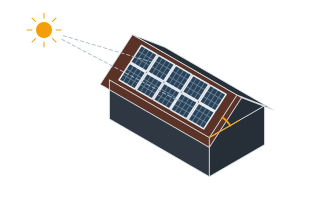
Nameplate DC of the array.
A laboratory rating at a standard test condition the roof effectively never sees. Real output sits below it in every month of the year — panel temperature alone takes a noticeable share on a warm day — and in winter, which is precisely when autonomy matters, short days and a low sun angle take far more. Sizing a winter question with a summer number is the commonest way an off-grid system disappoints its owner in January.
Daily solar resource at your site.
Roughly 2-3 in a northern winter, 4-6 in summer, 5-7 year-round in a sunny climate. Size an off-grid system on the WORST month, not the average — the average leaves you dark in December.
Autonomy
25.5 hours
Generation exceeds consumption on an average day at the stated sun hours.
- Usable energy
- 12.75 kWh
- Days at this load
- 1.06 days
- Daily consumption
- 12 kWh
- Daily generation after losses
- 12.04 kWh
- Daily surplus or shortfall
- 0.04 kWh
They open the calculator with your figures already in it
Off-Grid Autonomy Calculator: 25.5 hours — shown in imperial, US market. The link sets both, so the result they see is the one on your screen.
Show calculation logicHide calculation logic
How this was calculated
Formula source(s)
- Daily array yield = rated DC watts × peak sun hours × system derate; NREL PVWatts methodology
- Peak sun hours is the daily insolation in kWh/m² and varies by location and season — it is a site input, not a constant
Inputs used
- Battery nameplate (kWh)
- 15
- Usable share of nameplate (%)
- 85
- Continuous load (kW)
- 0.5
- Array size (kW DC)
- 4
- Peak sun hours per day
- 3.5
Intermediate steps
- Usable energy
- 12.75 kWh
- Days at this load
- 1.06 days
- Daily consumption
- 12 kWh
- Daily generation after losses
- 12.04 kWh
- Daily surplus or shortfall
- 0.04 kWh
Confidence note: Generation exceeds consumption on an average day at the stated sun hours.
What this calculation does not cover
- Peak sun hours vary by season by a factor of two or more. An off-grid system must be sized on the worst month, not the annual average.
- Assumes the load is constant. Real loads cycle, and a system that works on averages can still fail on a bad evening.
- Ignores charge-controller limits and the fact that a full battery cannot absorb surplus generation.
Computed in your browser — nothing you enter is uploaded. Presented in US customary units and US trade terminology. Where a formula follows a published standard, that standard and its edition are cited beside it on this page; where none governs, the page says so. Local amendments override model codes — verify against the code in force where you build.
Sources checked 2026-08-27 · in the site-wide review of 2026-09-06 · v1.0.0
Regulatory standards & verification citations2
- Daily array yield = rated DC watts × peak sun hours × system derate; NREL PVWatts methodology
- Peak sun hours is the daily insolation in kWh/m² and varies by location and season — it is a site input, not a constant
Cite this page
Your workspace
Most jobs need more than one number. Add the calculators you need next and they open right here, underneath this one — your figures stay on screen and nothing is lost to a page change.