
SettingsSettings for this calculationUS
At the water line.
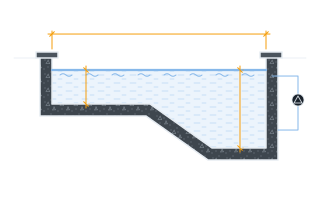
The rule is a share of the water's surface, because that is where a pool loses most of its heat. For a pool that is not a rectangle, enter a length and width whose product is its surface area.
At the water line.
Measured across, at right angles to the length.
How much of the year you swim, in the guide's terms.
More collector lengthens the swimming season and lets the pool be used in colder weather. A pool cover or blanket keeps the heat the collector gathers and extends the season further, which is why the two are usually bought together.
Collector area
381 sq ft
70% of the pool's surface, the guide's share for this season.
- Pool surface
- 544.5 sq ft
They open the calculator with your figures already in it
Solar Pool Heater Collector Size Calculator: 381 sq ft — shown in imperial, US market. The link sets both, so the result they see is the one on your screen.
Show calculation logicHide calculation logic
How this was calculated
Formula source(s)
- US Department of Energy, Heat Your Water with the Sun — A Consumer's Guide (DOE/GO-102003-1824, December 2003): solar pool heating requires a collector of 50% to 100% of the pool's surface area; a 15 by 30 ft Florida pool used year round typically takes 100%, 450 sq ft of unglazed flat-plate collectors; northern California pools used 6 to 8 months a year are typically sized at 60% to 70%
Inputs used
- Pool length
- 33 ft
- Pool width
- 16.5 ft
- Collector as a share of the pool's surface
- 70% — a 6-to-8-month season, upper end
Intermediate steps
- Pool surface
- 544.5 sq ft
Confidence note: 70% of the pool's surface, the guide's share for this season.
What this calculation does not cover
- This is the Department of Energy's rule of thumb, a share of the water surface. It is not a heat-loss calculation: wind, shade, the temperature you want and whether the pool is covered at night all change what a given collector achieves, and a design for a particular pool works from its heat loss.
- The rule counts collector area, not type. The guide's Florida example is unglazed flat-plate collector; glazed collectors are also made, and which suits a given pool and climate is the installer's choice, not something this share decides.
- The roof or rack has to hold the collector facing the sun, and the pool pump has to push water up to it and through it. Neither the space nor the pumping is checked here.
- A pool cover changes the answer more than the collector does on a cool night. The collector gathers the heat; the cover keeps it.
Computed in your browser — nothing you enter is uploaded. Presented in US customary units and US trade terminology. Where a formula follows a published standard, that standard and its edition are cited beside it on this page; where none governs, the page says so. Local amendments override model codes — verify against the code in force where you build.
Sources checked 2026-09-25 · v1.0.0
Regulatory standards & verification citations1
Cite this page
Your workspace
Most jobs need more than one number. Add the calculators you need next and they open right here, underneath this one — your figures stay on screen and nothing is lost to a page change.