
SettingsSettings for this calculationUS
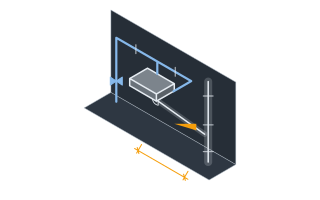
The roof's footprint on plan, for only the sections whose gutters and downpipes run to the tank.
Measure each connected roof section flat, as it would appear on a site plan, not up the slope: rain falls vertically, so a steep roof collects no more than its footprint. Leave out any section whose downpipes go to the stormwater drain or a soakaway, since none of its water reaches the tank. Sydney Water suggests a tank of at least 2,000 litres (528 US gal) connected to 75% or more of the roof as the minimum to consider, and says that getting as much roof as possible to flow to the tank does more for the savings than the tank's size.
Tools needed: Tape measure, Site plan or roof plan
Your own station's mean yearly rainfall: the Bureau of Meteorology in Australia, the Met Office in the UK, NOAA in the US.
The figure the page opens on is an example only, not anybody's rainfall, so replace it first. The Bureau of Meteorology publishes climate statistics for each Australian station with its mean annual rainfall; the Met Office gives 1991–2020 averages for UK climate stations; NOAA's U.S. Climate Normals give 1991–2020 station normals. Take the nearest station at a similar height, because rainfall changes quickly near hills and coasts. An average is the middle of a spread, and the dry year below it is the year the storage has to carry.
What fraction of the rain on the connected roof ends up in the tank, after the roof, the gutters and the filter or first-flush diverter take their share.
Approved Document G's rainwater calculation, the BS 8515 intermediate approach, multiplies area by rainfall by a 'yield coefficient and hydraulic filter efficiency': two factors, the share of the rain the roof sheds into its gutters and the share the filter passes on to the tank, which it takes together and gives one example for, 0.7. The page opens there, and this site's rainwater guides work to the same 0.7. Some of every shower is lost before the tank: the roof surface wets and dries off, water splashes past the gutter or evaporates, the first flush is diverted to waste and a filter rejects some. Where your filter or tank system's maker publishes a figure, use it. 1.0 would mean every drop arrives, which never happens.
Everyone in the household who draws on the uses the tank supplies.
Count the people living in the house, not the bedrooms. Approved Document G assumes two people in the first bedroom and one in each extra bedroom when it works out a new home's water use, which is a planning convention; the household as it actually lives is the better figure here.
Only the uses the tank supplies: a tank plumbed to the toilets and washing machine meets those, not the whole house's use.
Approved Document G's water calculator counts 1.46 full and 2.96 part flushes of a dual-flush WC a person a day, and 2.1 kg (4.6 lb) of washing. With the 6/4 litre (1.6/1.1 US gal) WC and the washing machine using 8.17 litres a kilogram (0.98 US gal a pound) in its Table 2.1, which is the most that table allows each fitting to use, that is about 20.6 litres (5.4 US gal) for the WC and 17.2 litres (4.5 US gal) for the washing, 37.8 litres (10.0 US gal) in all, rounded here to 38 litres (10.0 US gal). Thriftier fittings use less. Add a garden or anything else the tank feeds. For scale, the Australian Bureau of Statistics puts mains water use at 174 kL (46,000 US gal) a household in 2023–24, about 477 litres (126 US gal) a day for the whole household, and the US EPA puts home use at 82 US gallons (310 litres) a person a day.
How many days of the tank's daily flow a full tank holds: the smaller of what the household uses and what the roof gives on an average day.
The page opens on 18 days, the store this site's guide to sizing a rainwater harvesting tank works to: about five per cent of a year of the smaller flow (five per cent is 18.25 days), from the intermediate approach of BS 8515. That is a British standard, and its 18 days were set for UK rainfall, which falls fairly evenly through the year; where the dry season runs longer, as in much of Australia and parts of the US, the tank has longer to carry the house. BS 8515 was withdrawn in 2018 and replaced by BS EN 16941-1, whose basic approach BRE gives as the equivalent of the intermediate one. A dry season longer than 18 days is a reason to store more, as long as the roof can refill it; the store is never sized on more than the roof delivers, because a tank bigger than its roof can fill holds water that sits for months rather than flows. A month of autonomy on the household's use alone is the request that guide warns against.
Tank size for the days of storage chosen
720 gal
The tank holds 18 days of the smaller of two daily flows, what the household uses and what the roof gives on an average day, because a store bigger than the roof can refill or the house can use holds water that sits rather than flows. The yearly harvest is the connected roof's plan area times the annual rainfall times the share that reaches the tank, and it is an average year's figure, not a promise for a dry one.
- Rainwater a year from the roof
- 16,861.09 gal
- Rainwater the roof gives on an average day
- 46.19 gal
- Rainwater the household uses a day
- 40 gal
- Rainwater the household uses a year
- 14,600 gal
- Daily flow the tank is sized on, the smaller of the two
- 40 gal
- The roof's year as a share of the year's use
- 115.49 %
- Days of use one average year's harvest supplies
- 421.53 days
They open the calculator with your figures already in it
Rainwater Tank and Cistern Size Calculator: 720 gal — shown in imperial, US market. The link sets both, so the result they see is the one on your screen.
Show calculation logicHide calculation logic
How this was calculated
Formula source(s)
- HM Government, Approved Document G: Sanitation, hot water safety and water efficiency (2015 edition incorporating 2016 and 2024 amendments), Appendix A. Table A5.1, rainwater collection by the BS 8515 intermediate approach: daily rainwater collection = collection area (m²) × yield coefficient and hydraulic filter efficiency (e.g. 0.7) × average annual rainfall (mm) ÷ 365. Table A1 use factors: a dual-flush WC used 1.46 times at full flush and 2.96 times at part flush a person a day (4.42 in all), and 2.1 kg of washing a person a day. Table 2.1 fittings: a 6/4 litre dual-flush WC and a washing machine using 8.17 litres a kilogram. Paragraph A24: for sizing storage capacity, BS 8515 should be followed
- Australian Bureau of Statistics, Water Account, Australia, 2023–24 (released 11 December 2025): average household water use rose from 168 kL to 174 kL per household from 2022–23 to 2023–24; household water use does not include self-extracted water such as rainwater tanks and bores
- Sydney Water, Rainwater tanks: a minimum tank size of 2,000 litres connected to 75% or more of the roof area as the smallest to consider; maximising the roof area flowing to the tank is the best way to maximise water savings, regardless of tank size
- US EPA WaterSense, Statistics and Facts: each American uses an average of 82 gallons of water a day at home (USGS, Estimated Use of Water in the United States in 2015)
- Station rainfall averages for 1991–2020: Met Office, UK climate averages (location-specific long-term averages), and NOAA NCEI, U.S. Climate Normals; in Australia, the Bureau of Meteorology's climate statistics for each station
- BRE, BREEAM Knowledge Base, KBCN1179 (18 September 2018): BS 8515:2009 (+A1:2013) has been withdrawn and replaced by BS EN 16941-1:2018, and the basic approach in BS EN 16941 is equivalent to the intermediate approach in BS 8515. BSI lists BS 8515:2009+A1:2013 as withdrawn on 19 July 2018, and BS EN 16941-1:2024 as the current edition
Inputs used
- Roof Area Draining to the Tank
- 1610 sq ft
- Average Annual Rainfall Where You Are
- 24 in
- Share of the Rain That Reaches the Tank (0 to 1)
- 0.7
- People Using the Water
- 4
- Rainwater Used per Person per Day
- 10 gal
- Days of Storage
- 18
Intermediate steps
- Rainwater a year from the roof
- 16,861.09 gal
- Rainwater the roof gives on an average day
- 46.19 gal
- Rainwater the household uses a day
- 40 gal
- Rainwater the household uses a year
- 14,600 gal
- Daily flow the tank is sized on, the smaller of the two
- 40 gal
- The roof's year as a share of the year's use
- 115.49 %
- Days of use one average year's harvest supplies
- 421.53 days
Confidence note: The tank holds 18 days of the smaller of two daily flows, what the household uses and what the roof gives on an average day, because a store bigger than the roof can refill or the house can use holds water that sits rather than flows. The yearly harvest is the connected roof's plan area times the annual rainfall times the share that reaches the tank, and it is an average year's figure, not a promise for a dry one.
What this calculation does not cover
- This is a year's balance, not a day-by-day one. Rain comes in bursts with dry spells between them, so the tank is refilled only when it rains, and in a long dry season it can run empty however generous the yearly harvest looks. Sizing that follows a tank day by day through a local rainfall record is the detailed approach in BS 8515, to which Approved Document G refers storage sizing; this page does not have that record.
- The share of rain reaching the tank is one figure for the whole year. A light shower can wet the roof without running off at all, and a cloudburst can overtop the gutters, so what each storm delivers swings either side of it.
- Overflow is not counted against the harvest. Once the tank is full, more rain leaves by the overflow, so through a wet season the household keeps less than the roof sheds, and a small tank on a big roof sends much of a wet spell straight over it.
- The use per person is whatever is entered. A tank on the toilets and the washing machine meets those uses only; a garden in a dry summer, a pool top-up or a whole-house connection draws far more, and the household's own meter readings beat any typical figure.
- Nothing here makes the water safe to drink or settles how the tank is connected. Joining a tank to a house's pipework brings the plumbing rules where you live with it, including backflow protection where it meets the mains supply, and drinking rainwater needs treatment or testing that is outside this page. Councils and water authorities can also set or require tank sizes for new homes.
Estimated cost — your price
This site holds no price list for this material — local prices vary too much to publish honestly. Enter your supplier's price and the result is costed with it.
Computed in your browser — nothing you enter is uploaded. Presented in US customary units and US trade terminology. Where a formula follows a published standard, that standard and its edition are cited beside it on this page; where none governs, the page says so. Local amendments override model codes — verify against the code in force where you build.
Sources checked 2026-10-05 · v1.0.0
Regulatory standards & verification citations6
- HM Government, Approved Document G: Sanitation, hot water safety and water efficiency (2015 edition incorporating 2016 and 2024 amendments), Appendix A. Table A5.1, rainwater collection by the BS 8515 intermediate approach: daily rainwater collection = collection area (m²) × yield coefficient and hydraulic filter efficiency (e.g. 0.7) × average annual rainfall (mm) ÷ 365. Table A1 use factors: a dual-flush WC used 1.46 times at full flush and 2.96 times at part flush a person a day (4.42 in all), and 2.1 kg of washing a person a day. Table 2.1 fittings: a 6/4 litre dual-flush WC and a washing machine using 8.17 litres a kilogram. Paragraph A24: for sizing storage capacity, BS 8515 should be followed
- Australian Bureau of Statistics, Water Account, Australia, 2023–24 (released 11 December 2025): average household water use rose from 168 kL to 174 kL per household from 2022–23 to 2023–24; household water use does not include self-extracted water such as rainwater tanks and bores
- Sydney Water, Rainwater tanks: a minimum tank size of 2,000 litres connected to 75% or more of the roof area as the smallest to consider; maximising the roof area flowing to the tank is the best way to maximise water savings, regardless of tank size
- US EPA WaterSense, Statistics and Facts: each American uses an average of 82 gallons of water a day at home (USGS, Estimated Use of Water in the United States in 2015)
- Station rainfall averages for 1991–2020: Met Office, UK climate averages (location-specific long-term averages), and NOAA NCEI, U.S. Climate Normals; in Australia, the Bureau of Meteorology's climate statistics for each station
- BRE, BREEAM Knowledge Base, KBCN1179 (18 September 2018): BS 8515:2009 (+A1:2013) has been withdrawn and replaced by BS EN 16941-1:2018, and the basic approach in BS EN 16941 is equivalent to the intermediate approach in BS 8515. BSI lists BS 8515:2009+A1:2013 as withdrawn on 19 July 2018, and BS EN 16941-1:2024 as the current edition
Which documents these citations point at
- Approved Documents to the Building Regulations (England) — G (United Kingdom)Practical guidance on meeting the Building Regulations, one lettered part per subject — Part A structure, Part B fire, Part K protection from falling, Part L conservation of fuel and power, and the rest.
Standards referenced: BS EN 16941-1, BS EN 16941 (European Committee for Standardization, as published in the UK by BSI, European (EN)).
A code or standard has force only where a jurisdiction has adopted it, usually with local amendments. This site holds no adoption data for any authority, so check what is in force with the authority where you build. Any section cited above without an edition should be checked against the edition in force where you build. What it would take to know.
Cite this page
Your workspace
Most jobs need more than one number. Add the calculators you need next and they open right here, underneath this one — your figures stay on screen and nothing is lost to a page change.