
SettingsSettings for this calculationUS
The standard allowance most suppliers and estimating guides assume for ordinary work.
The volume of wet mortar the job needs.
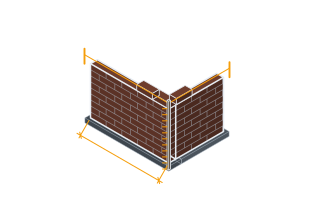
Take it from a bricklaying or blockwork quantity rather than guessing: mortar volume per square metre of wall depends on the unit size and the joint thickness, and a 10 mm joint in blockwork is a very different quantity from the same joint in brick.
The ASTM C270 type, which sets how much lime goes in per part of cement.
More lime means a weaker, more workable and more forgiving mortar. Stronger is not better: mortar should be weaker than the units it beds, so that movement cracks the joint rather than the brick, and a joint is repointable where a cracked brick is not.
Volumes of sand per combined volume of cement and lime.
ASTM C270 allows 2 1/4 to 3, and the bounds here are those limits. Three is the usual working figure and the most economical; dropping toward 2 1/4 gives a richer, stickier mortar that some bricklayers prefer in cold weather or with very absorbent units.
Percentage added for droppings, board waste and part batches.
Mortar has a working life of a couple of hours and cannot be retempered indefinitely, so the last of a batch is often thrown. Ten per cent covers ordinary walling; raise it for pointing and for small intricate work where each batch is part-used.
Sand needed
38.5 ft³
Type N: 1 part cement to 0.875 lime to 3 sand, by volume. The standard allows 0.5 to 1.25 parts lime for this type — use the ratio your specification names if it gives one. Suits most above-grade exterior and interior load-bearing walls, and the usual default. This is the proportion specification and does not certify a strength.
- Cement
- 6.84 ft³
- Hydrated lime
- 5.99 ft³
- Sand
- 38.5 ft³
- 94 lb sacks (1 ft³ each)
- 7 sacks
- Mortar after waste
- 38.5 ft³
They open the calculator with your figures already in it
Mortar Mix Calculator (ASTM C270 Types M, S, N, O): 38.5 ft³ — shown in imperial, US market. The link sets both, so the result they see is the one on your screen.
Show calculation logicHide calculation logic
How this was calculated
Formula source(s)
- Proportions are the ASTM C270 PROPORTION specification, parts by volume per 1 part portland cement: Type M 1/4 lime, Type S over 1/4 to 1/2, Type N over 1/2 to 1 1/4, Type O over 1 1/4 to 2 1/2. The midpoint of each band is used as the nominal and both ends are shown
- Aggregate is not less than 2 1/4 and not more than 3 times the sum of the cementitious volumes, which is why the sand ratio is an input bounded at those limits rather than a fixed figure
- Wet yield is taken as the sand volume, because the binder paste occupies the voids between sand grains rather than adding to them — a trade convention stated here rather than a measured property, and it moves with the sand's grading
- A US sack of portland cement is 94 lb and one cubic foot by definition, so that bag volume is exact. The 25 kg metric bag volume assumes a loose bulk density near 1,500 kg per cubic metre and is an assumption, not a definition
Inputs used
- Mortar needed
- 35 ft³
- Mortar type
- Type N — general purpose, exterior above grade
- Sand per part of binder
- 3
- Waste allowance
- 10
Intermediate steps
- Cement
- 6.84 ft³
- Hydrated lime
- 5.99 ft³
- Sand
- 38.5 ft³
- 94 lb sacks (1 ft³ each)
- 7 sacks
- Mortar after waste
- 38.5 ft³
Confidence note: Type N: 1 part cement to 0.875 lime to 3 sand, by volume. The standard allows 0.5 to 1.25 parts lime for this type — use the ratio your specification names if it gives one. Suits most above-grade exterior and interior load-bearing walls, and the usual default. This is the proportion specification and does not certify a strength.
What this calculation does not cover
- This is the PROPORTION specification of ASTM C270 and it certifies no strength. A mortar batched to these volumes has not been tested, and the compressive strengths in the standard's property table belong to laboratory specimens prepared a different way. Never state that a proportion-batched mortar meets a property specification.
- Yield is taken as the sand volume, which is a trade convention rather than a measured property. Sand grading moves it: a well-graded sand has fewer voids for the paste to fill and yields slightly more than its own volume, a single-sized sand rather less.
- Sand is assumed batched DAMP and by volume, as it is on site. Damp sand bulks by a fifth to a third, so a volume batch of dry sand puts materially more sand into the mix than intended — which is a weaker mortar, not a stronger one.
- The lime figure is the midpoint of the band the standard allows for that type. Where a specification names a ratio, use theirs; the band is wide for Types N and O and the ends behave noticeably differently.
- Masonry cement and mortar cement are not covered. Both replace the separate cement-and-lime pair with a single bagged product, their C270 proportion rows are different, and substituting one for the other at these volumes gives the wrong mix.
- Nothing here addresses colour, admixtures, or matching an existing mortar. Repointing historic masonry is a different problem in which a cement-based mortar of any C270 type may be the wrong answer entirely.
Estimated cost — your price
This site holds no price list for this material — local prices vary too much to publish honestly. Enter your supplier's price and the result is costed with it.
Part of a bigger job
This trade is one line of a job takeoff. Run the whole job and every other trade comes back with it, off the same measurements.
Computed in your browser — nothing you enter is uploaded. Presented in US customary units and US trade terminology. Where a formula follows a published standard, that standard and its edition are cited beside it on this page; where none governs, the page says so. Local amendments override model codes — verify against the code in force where you build.
Sources checked 2026-09-15 · v1.0.0
Regulatory standards & verification citations4
- Proportions are the ASTM C270 PROPORTION specification, parts by volume per 1 part portland cement: Type M 1/4 lime, Type S over 1/4 to 1/2, Type N over 1/2 to 1 1/4, Type O over 1 1/4 to 2 1/2. The midpoint of each band is used as the nominal and both ends are shown
- Aggregate is not less than 2 1/4 and not more than 3 times the sum of the cementitious volumes, which is why the sand ratio is an input bounded at those limits rather than a fixed figure
- Wet yield is taken as the sand volume, because the binder paste occupies the voids between sand grains rather than adding to them — a trade convention stated here rather than a measured property, and it moves with the sand's grading
- A US sack of portland cement is 94 lb and one cubic foot by definition, so that bag volume is exact. The 25 kg metric bag volume assumes a loose bulk density near 1,500 kg per cubic metre and is an assumption, not a definition
Which documents these citations point at
Standards referenced: ASTM C270 (ASTM International, United States).
Cite this page
Your workspace
Most jobs need more than one number. Add the calculators you need next and they open right here, underneath this one — your figures stay on screen and nothing is lost to a page change.
Tools and safety for this job
To mix adhesive or mortar and mix mortar. Generic types, no brands, no prices.
Protection this work requires
- Cutting or grinding concrete, masonry, screed, tile or fibre-cement board releases respirable silica: cut wet or extract at the tool, and wear a P2/N95 respirator at minimum — a nuisance dust mask does not filter it.
- Wet cement and lime burn skin and eyes painlessly until the damage is done: waterproof gloves to EN 374, safety glasses whenever the mix can splash, and never kneel in wet mix in permeable trousers.
Show the 5 tools this job needsHide tools
Essential
Mixing bucket or tub
Paddle mixer
Shovel and spade
Wheelbarrow
Recommended
Cement mixer
what each tiling tool is for and what each masonry tool is for, and the spec that decides which to buy where one does.