
SettingsSettings for this calculationUS
The liquid limit less the plastic limit, from Atterberg limits tests on the fraction finer than 425 µm.
Run to BS 1377-2 or BS EN ISO 17892-12 in the UK, ASTM D4318 in North America, on a disturbed sample from the depth the foundation will reach. The test itself is done on the particles passing the 425 µm sieve, which is why the result is then scaled by how much of the soil that fraction is.
The percentage by mass of the soil finer than 425 µm (the No. 40 sieve), from the grading.
Sand and gravel coarser than 425 µm take no part in the swelling, so a clay that is a third sand behaves like a leaner clay than its plasticity index says. For a pure clay with everything passing, enter 100 and the modified index equals the plasticity index.
The clay and silt content — particles finer than 60 µm — from the grading.
NHBC treats a soil as shrinkable only when it has over 35 per cent of these fine particles as well as a modified plasticity index of 10 per cent or more.
The species' water demand category from NHBC Chapter 4.2; assume high if the species is not identified.
A property of the species, not the site. A high-demand tree read as moderate changes nothing on the drawing and everything at the building a few dry summers later.
The published mature height of the species, not the height of the tree standing there today.
NHBC's table gives the height healthy trees of the species reach. A young high-demand tree measured at eight metres and entered as eight produces a generous D/H and a foundation designed for a tree that will not exist in twenty years.
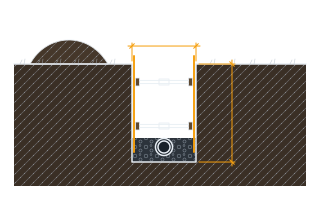
From the centre of the stem to the nearest part of the new foundation.
Measured on plan to the closest point of the foundation itself, so a trench that steps out at a corner is measured to the corner.
Modified plasticity index (I′p)
30.15 %
NHBC Chapter 4.2 bands this as medium volume change potential. The foundation sits inside the high-demand tree's zone of influence, so NHBC Chapter 4.2 applies to its design; the depth comes from the chapter's charts, which take the volume change potential, the water demand and D/H together.
- Plasticity index
- 45 %
- Share passing 425 µm
- 67 %
- D/H
- 0.45
- Lateral zone of influence of the tree
- 82.5 ft
- Distance from the tree to the foundation
- 30 ft
They open the calculator with your figures already in it
Modified Plasticity Index Calculator (NHBC 4.2 Volume Change Potential): 30.15 % — shown in imperial, US market. The link sets both, so the result they see is the one on your screen.
Show calculation logicHide calculation logic
How this was calculated
Formula source(s)
- NHBC Standards 2024, Chapter 4.2 Building near trees: modified plasticity index I′p = Ip × (% of particles less than 425 µm) ÷ 100%; Table 1 bands 40% and greater high, 20% to less than 40% medium and 10% to less than 20% low volume change potential; shrinkable soils have over 35% fine particles and a modified plasticity index of 10% or greater; high volume change potential is assumed when it is unknown
- NHBC Standards 2024, Chapter 4.2 Table 3b: the lateral zone of influence of a tree is 1.25 × mature height for high water demand species, 0.75 × for moderate and 0.5 × for low; H is the species' mature height from Table 3, and D the distance from the tree to the foundation
Inputs used
- Plasticity Index Ip, per cent
- 45
- Share Passing the 425 µm Sieve, per cent
- 67
- Fine Particles Below 60 µm, per cent
- 80
- Water Demand of the Nearest Tree
- High — oaks, willows, poplars, elms and others in the NHBC table
- Mature Height of the Species (H)
- 66 ft
- Distance from the Tree to the Foundation (D)
- 30 ft
Intermediate steps
- Plasticity index
- 45 %
- Share passing 425 µm
- 67 %
- D/H
- 0.45
- Lateral zone of influence of the tree
- 82.5 ft
- Distance from the tree to the foundation
- 30 ft
Confidence note: NHBC Chapter 4.2 bands this as medium volume change potential. The foundation sits inside the high-demand tree's zone of influence, so NHBC Chapter 4.2 applies to its design; the depth comes from the chapter's charts, which take the volume change potential, the water demand and D/H together.
What this calculation does not cover
- It classifies the sample you tested. Clay varies with depth and across a site, and NHBC asks for enough samples to be confident the result is representative; one test from one hole is one data point.
- It does not give a foundation depth. NHBC Chapter 4.2 converts volume change potential, water demand and D/H into a minimum depth through its charts and tables, which are revised from edition to edition and need all three inputs right; the engineer reads them, and this page stops before them.
- Trees removed recently, or about to be, change the question from shrinkage to heave, and a tree's height for that purpose is set by the chapter's own rules rather than by the mature height entered here.
Computed in your browser — nothing you enter is uploaded. Presented in US customary units and US trade terminology. Where a formula follows a published standard, that standard and its edition are cited beside it on this page; where none governs, the page says so. Local amendments override model codes — verify against the code in force where you build.
Sources checked 2026-09-22 · v1.0.0
Regulatory standards & verification citations2
- NHBC Standards 2024, Chapter 4.2 Building near trees: modified plasticity index I′p = Ip × (% of particles less than 425 µm) ÷ 100%; Table 1 bands 40% and greater high, 20% to less than 40% medium and 10% to less than 20% low volume change potential; shrinkable soils have over 35% fine particles and a modified plasticity index of 10% or greater; high volume change potential is assumed when it is unknown
- NHBC Standards 2024, Chapter 4.2 Table 3b: the lateral zone of influence of a tree is 1.25 × mature height for high water demand species, 0.75 × for moderate and 0.5 × for low; H is the species' mature height from Table 3, and D the distance from the tree to the foundation
Cite this page
Your workspace
Most jobs need more than one number. Add the calculators you need next and they open right here, underneath this one — your figures stay on screen and nothing is lost to a page change.