
SettingsSettings for this calculationUS
The British standard's root protection area, or the Australian standard's notional root zone.
Both start from twelve times the stem diameter. BS 5837 measures the stem at 1.5 m (4 ft 11 in) and caps the AREA at 707 m² (7,610 sq ft); AS 4970 measures at 1.4 m (4 ft 7 in), holds the RADIUS between 2 m (6 ft 7 in) and 15 m (49 ft), and adds a structural root zone for the tree's stability. In AS 4970:2025 the figure is the notional root zone, the starting point from which the project arborist sets the tree protection zone.
Trees that fork below the measuring height are treated as several stems combined into one diameter.
Two to five stems combine as the square root of the sum of their squares, which gives the diameter of a single stem with the same total cross-section. For more than five, BS 5837 uses the mean diameter times the square root of the count, which is the same thing for stems of equal size.
The stem's diameter at 1.5 m (4 ft 11 in) above ground for BS 5837, or 1.4 m (4 ft 7 in) for AS 4970; the first stem of a forked tree.
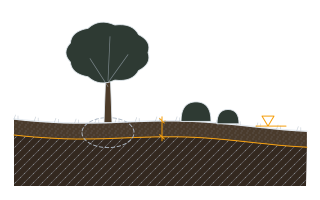
Measure the girth with a tape and divide by π, or use a diameter tape. On sloping ground take the height from the upper side. The diameter is of the stem, not of the crown you can see, and the crown is no guide to where the roots are.
From the centre of the stem to the nearest edge of the excavation, trench or structure.
Measure on plan to the closest point the works reach, including the working space and any batter, not just the line of the foundation on the drawing.
Radius of the protected area
24 ft
Twelve times the stem diameter as the radius of a circle. BS 5837 lets the arboriculturist change the circle's shape to follow the roots actually present, keeping the area the same, so the circle is the starting geometry rather than the only one. The nearest works sit outside the protected circle.
- Stem diameter
- 24 in
- Root protection area
- 1,809.56 ft²
- Distance from the stem to the works
- 30 ft
- Works beyond the edge (negative: inside it)
- 6 ft
They open the calculator with your figures already in it
Tree Root Protection Area Calculator (BS 5837 RPA and AS 4970 Notional Root Zone): 24 ft — shown in imperial, US market. The link sets both, so the result they see is the one on your screen.
Show calculation logicHide calculation logic
How this was calculated
Formula source(s)
- BS 5837:2012 Trees in relation to design, demolition and construction, 4.6.1 and Annexes C and D: the root protection area is a circle whose radius is twelve times the stem diameter measured at 1.5 m above ground, capped at 707 m²; for two to five stems the combined diameter is √(d1² + d2² + …), and for more than five the mean stem diameter × √(number of stems)
- AS 4970:2025 Protection of trees on development sites (the second edition, which superseded AS 4970-2009): notional root zone radius = 12 × the diameter at standard height, 1.4 m, no less than 2 m and no more than 15 m, stems combined as √(Σd²); structural root zone radius = (D × 50)^0.42 × 0.64 from the diameter D just above the root buttress, no less than 1.5 m
Inputs used
- Standard
- BS 5837:2012 — root protection area (UK)
- Number of Stems
- One stem
- Stem Diameter
- 24 in
- Stem 2 Diameter (0 if none)
- 11.75 in
- Stem 3 Diameter (0 if none)
- 9.75 in
- Stem 4 Diameter (0 if none)
- 0 in
- Stem 5 Diameter (0 if none)
- 0 in
- Mean Stem Diameter
- 6 in
- Number of Stems (count)
- 8
- Trunk Diameter Above the Root Buttress (0 to skip)
- 28 in
- Distance from the Stem to the Nearest Works (0 to skip)
- 30 ft
Intermediate steps
- Stem diameter
- 24 in
- Root protection area
- 1,809.56 ft²
- Distance from the stem to the works
- 30 ft
- Works beyond the edge (negative: inside it)
- 6 ft
Confidence note: Twelve times the stem diameter as the radius of a circle. BS 5837 lets the arboriculturist change the circle's shape to follow the roots actually present, keeping the area the same, so the circle is the starting geometry rather than the only one. The nearest works sit outside the protected circle.
What this calculation does not cover
- It sets out the standard's geometry from the diameter you measured. It does not assess the tree's condition, its species' tolerance of root loss, or whether a Tree Preservation Order, a conservation area or a planning condition applies — those sit with the arboricultural report and the planning authority.
- A circle about the stem. Roots follow the ground, not the geometry: a kerb, a building, a watercourse or a change in level can confine them to one side, and the arboriculturist may reshape the protected area to match, keeping its area.
- A tree's roots also affect the ground well beyond the protected area. On shrinkable clay the foundations near it are a separate question, set by the soil's volume change potential, the species' water demand and its mature height — see the modified plasticity index calculator.
Computed in your browser — nothing you enter is uploaded. Presented in US customary units and US trade terminology. Where a formula follows a published standard, that standard and its edition are cited beside it on this page; where none governs, the page says so. Local amendments override model codes — verify against the code in force where you build.
Sources checked 2026-09-22 · v1.0.0
Regulatory standards & verification citations2
- BS 5837:2012 Trees in relation to design, demolition and construction, 4.6.1 and Annexes C and D: the root protection area is a circle whose radius is twelve times the stem diameter measured at 1.5 m above ground, capped at 707 m²; for two to five stems the combined diameter is √(d1² + d2² + …), and for more than five the mean stem diameter × √(number of stems)
- AS 4970:2025 Protection of trees on development sites (the second edition, which superseded AS 4970-2009): notional root zone radius = 12 × the diameter at standard height, 1.4 m, no less than 2 m and no more than 15 m, stems combined as √(Σd²); structural root zone radius = (D × 50)^0.42 × 0.64 from the diameter D just above the root buttress, no less than 1.5 m
Cite this page
Your workspace
Most jobs need more than one number. Add the calculators you need next and they open right here, underneath this one — your figures stay on screen and nothing is lost to a page change.