
SettingsSettings for this calculationUS
The clear span between supports, centre to centre of bearing.
Span dominates this calculation more than anything else, because it enters to the fourth power under a square root — frequency falls with the square of the span. Doubling a span at constant section and load quarters the frequency.
The section's second moment of area about the bending axis, from its published properties.
Take it from the section tables for the exact serial size. Working from a US table quoted as I in in⁴? Multiply by 0.4162 to get ×10⁶ mm⁴ — a W16x31 at 375 in⁴ is 156 in these units. Where the beam acts compositely with a slab, use the composite value, which can be two or three times the bare section.
The stiffness of the beam material.
Structural steel is 200,000 MPa (29,000,000 psi) and that is the default here. Glulam runs around 11,000 MPa (1,600,000 psi), and normal-weight concrete rather less. For vibration, use the dynamic modulus where one is published — it is typically a little higher than the static value.
The mass this beam carries along its length, including its own, at the loading present in service.
Vibration is assessed under the load actually there day to day, not the factored design load — the permanent load plus a small allowance for occupancy, often taken as a fraction of the design live load. Loading a floor up for a code check makes it look better than it feels.
How quickly the floor's motion dies away, as a percentage of critical damping.
This is an assessment, not a measurement. A bare structure with nothing on it sits near 1 to 2 per cent; an office with ceilings, ductwork and full-height partitions reaches 3 to 5. Partitions are the single biggest contributor, which is why an open plan fit-out can make an acceptable floor unacceptable.
Fundamental natural frequency
5.94 Hz
This is a low-frequency floor, so a walking harmonic can resonate it and the response is governed by that resonance. Frequency alone does not settle whether it is acceptable — the full Design Guide 11 acceleration check, which needs the effective panel weight, does.
- Static deflection under the supported mass
- 0.35 in
- Dynamic amplification at resonance
- 16.67 (× static)
- Walking pace whose second harmonic matches this floor
- 178.23 steps/min
- Walking pace whose third harmonic matches this floor
- 118.82 steps/min
They open the calculator with your figures already in it
Floor Beam Vibration Natural Frequency Calculator: 5.94 Hz — shown in imperial, US market. The link sets both, so the result they see is the one on your screen.
Show calculation logicHide calculation logic
How this was calculated
Formula source(s)
- Fundamental frequency of a uniform simply supported beam, f₁ = (π/2)·√(E·I / (m·L⁴)), with m the supported mass per unit length — the classical closed form, and the same relationship AISC Design Guide 11 expresses as f = 0.18·√(g/Δ) through the static deflection
- AISC Design Guide 11, Vibrations of Steel-Framed Structural Systems Due to Human Activity — floors below about 3 Hz can be resonated by the first harmonic of walking, and floors above roughly 9 to 10 Hz respond impulsively rather than resonantly, which is why the two thresholds appear in the note under the result
- Dynamic amplification at resonance = 1 / (2ζ) for a single-degree-of-freedom system, which is where the damping ratio enters. Damping ratios for floors are assessed, not measured — a bare structure is nearer 1–2%, a fitted-out office with partitions nearer 3–5%
- This page reports FREQUENCY, not the Design Guide 11 acceleration ratio. That check needs the effective weight of the vibrating panel, which comes from the guide's own joist-and-girder panel procedure and cannot be derived from a single beam's properties
Inputs used
- Beam Span
- 30 ft
- Second Moment of Area I (×10⁶ mm⁴)
- 300
- Modulus of Elasticity E
- 29007547.55 psi
- Supported Mass per Unit Length
- 403.18 lb/ft
- Damping Ratio (% of critical)
- 3
Intermediate steps
- Static deflection under the supported mass
- 0.35 in
- Dynamic amplification at resonance
- 16.67 (× static)
- Walking pace whose second harmonic matches this floor
- 178.23 steps/min
- Walking pace whose third harmonic matches this floor
- 118.82 steps/min
Confidence note: This is a low-frequency floor, so a walking harmonic can resonate it and the response is governed by that resonance. Frequency alone does not settle whether it is acceptable — the full Design Guide 11 acceleration check, which needs the effective panel weight, does.
What this calculation does not cover
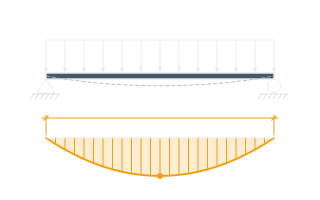
- A single simply supported beam. A real floor vibrates as a panel of joists on girders, and the panel frequency is lower than any of its parts — Design Guide 11's combined-mode procedure exists for exactly that reason.
- Continuity, fixity and adjacent bays are not modelled. A continuous beam over several supports is stiffer and its frequency higher than this.
- Says nothing about acceleration, which is what people actually feel. Two floors at the same frequency can be worlds apart in comfort depending on effective panel weight and damping.
Add the equipment this sizes
This result is a specification — 5.94 Hz — not a quantity. Put the thing it sizes into your project: how many, what you call it, and your supplier’s price.
Computed in your browser — nothing you enter is uploaded. Presented in US customary units and US trade terminology. Where a formula follows a published standard, that standard and its edition are cited beside it on this page; where none governs, the page says so. Local amendments override model codes — verify against the code in force where you build.
Sources checked 2026-08-30 · in the site-wide review of 2026-09-06 · v1.0.0
Regulatory standards & verification citations4
- Fundamental frequency of a uniform simply supported beam, f₁ = (π/2)·√(E·I / (m·L⁴)), with m the supported mass per unit length — the classical closed form, and the same relationship AISC Design Guide 11 expresses as f = 0.18·√(g/Δ) through the static deflection
- AISC Design Guide 11, Vibrations of Steel-Framed Structural Systems Due to Human Activity — floors below about 3 Hz can be resonated by the first harmonic of walking, and floors above roughly 9 to 10 Hz respond impulsively rather than resonantly, which is why the two thresholds appear in the note under the result
- Dynamic amplification at resonance = 1 / (2ζ) for a single-degree-of-freedom system, which is where the damping ratio enters. Damping ratios for floors are assessed, not measured — a bare structure is nearer 1–2%, a fitted-out office with partitions nearer 3–5%
- This page reports FREQUENCY, not the Design Guide 11 acceleration ratio. That check needs the effective weight of the vibrating panel, which comes from the guide's own joist-and-girder panel procedure and cannot be derived from a single beam's properties
Cite this page
Your workspace
Most jobs need more than one number. Add the calculators you need next and they open right here, underneath this one — your figures stay on screen and nothing is lost to a page change.