
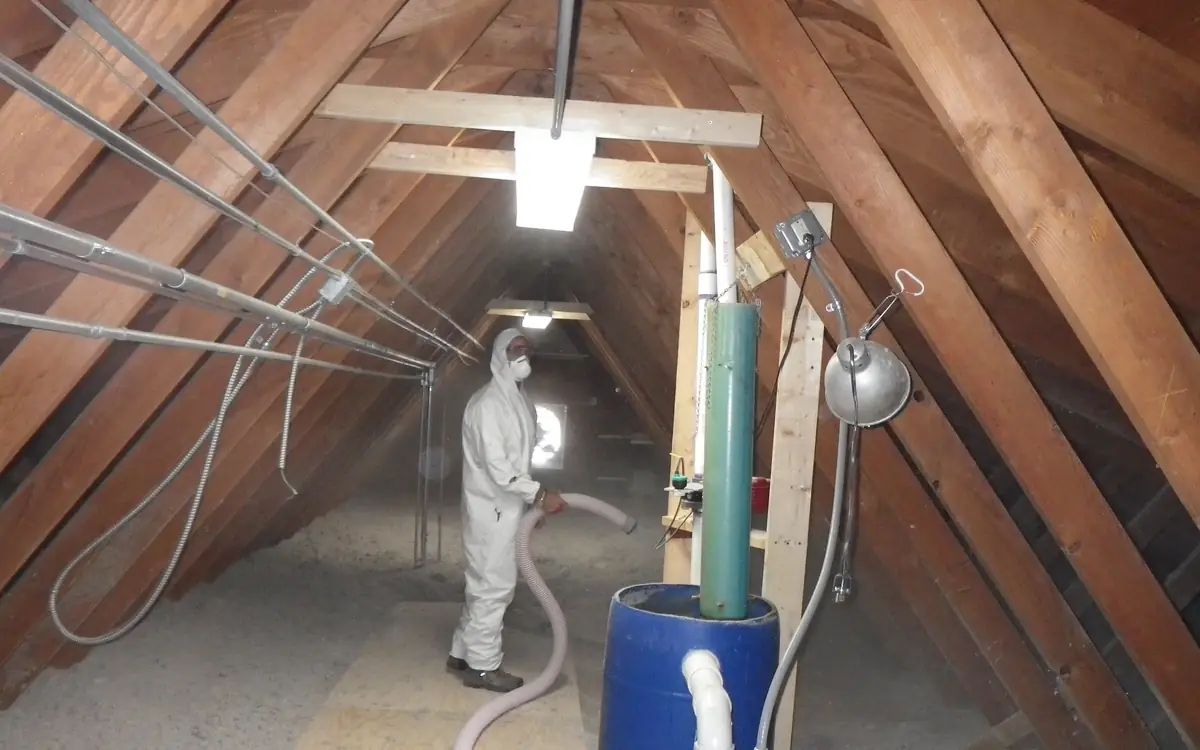
How the two differ in kind
Moisture gets into a building assembly two ways, and the two are constantly confused because the products look similar and are often the same sheet of material.
DIFFUSION is water vapour moving through a solid material, molecule by molecule, driven by the difference in vapour pressure across it. It is real, it is what a vapour barrier or retarder addresses, and it is SLOW.
AIR TRANSPORT is moist air moving bodily through an opening, driven by a pressure difference — wind, the stack effect, or a fan. Every cubic metre of warm indoor air carries its water with it, and a modest gap under a modest pressure difference moves a great deal of air over a winter. The quantity of moisture delivered this way is routinely one to two orders of magnitude greater than diffusion through the same assembly.
That ratio is the whole argument, and it has a direct consequence: a vapour barrier stapled up with gaps at every stud, torn at every socket and open at the top plate is not a vapour barrier problem, it is an air barrier absence — and the moisture arriving through those openings dwarfs anything the intact sheet is preventing. Air sealing is therefore the first job, the cheaper job, and the one with the larger return. The vapour barrier still has a role, but a smaller one than its name implies, and its position matters in a way an air barrier's does not: an air barrier works on either side of an assembly, while a vapour barrier on the wrong side of it for the climate traps moisture rather than excluding it.
The factors that actually differ
| Vapour barrier | Air sealing | |
|---|---|---|
| What it stops | Vapour diffusing through a material down a vapour-pressure gradient. | Moist air moving bodily through openings under a pressure difference. |
| How much moisture that is | The smaller share, in most assemblies by a wide margin. | The larger share — commonly one to two orders of magnitude more. |
| Does the side matter | Critically. Warm-in-winter side in a heating climate; a poly sheet on the interior of a wall in a hot humid climate is a recognised failure. | No. An air barrier works on either face, provided it is continuous. |
| What ruins it | Being on the wrong side, or having a second one on the opposite side so the assembly cannot dry either way. | Any discontinuity. A barrier that is 95% complete performs far worse than 95% of a complete one. |
| Other benefits | None beyond moisture. | Substantial — comfort, draughts, heating and cooling cost, dust, noise, and the effectiveness of the insulation itself. |
| Where the money goes | A membrane across a plane, or a vapour-retarding paint. | The bypasses: top plates, recessed lights, plumbing stacks, chimney chases, the loft hatch, wiring penetrations, rim joists. |
| Effect on insulation | None directly. | Large. Insulation with air moving through or around it performs far below its rating — and loft insulation over an unsealed ceiling is being ventilated from beneath. |
| How it is verified | By inspection and by knowing the material's permeance class. | By a blower door test, which gives a number rather than an impression. |
| Can one material do both | Yes — many membranes are both, which is exactly why the two get conflated. | Yes, and if it is doing both, the vapour-side rule applies to where it sits. |
| Order of work | Second, and specified for the climate. | First, always. It is cheaper, it returns more, and it changes what the assembly needs. |
Which one, and when
Choose vapour barrier when…
- The assembly's design calls for a specified vapour control layer on a specified side — follow it.
- A cold climate with a clear heating season, where the interior side is reliably the warm side.
- A specific high-moisture interior — a pool hall, a commercial kitchen, a drying room.
- There is a slab or a crawl space with exposed ground, where a ground vapour barrier is genuinely the intervention that matters.
Choose air sealing when…
- Always, and before anything else — there is no assembly that does not benefit.
- The attic has visible bypasses, frost on the underside of the deck, or melt patterns on the roof snow.
- Comfort, draughts and heating cost are complaints as well as moisture.
- Insulation is about to be added, which is the moment sealing is both cheapest and most necessary.
Now run your own numbers
This page holds no prices on purpose — a national average is wrong for almost every real project. Quantify both options with your dimensions and your local quotes.
Frequently asked questions
- Why does air leakage carry so much more moisture than diffusion?
- Because it moves the air itself rather than only the water in it. Diffusion is individual vapour molecules working their way through a solid material down a pressure gradient, and even a modestly vapour-resistant material slows that to a trickle. Air transport moves whole volumes: a gap with a pressure difference across it passes a continuous stream of air, and every cubic metre brings its entire moisture content along. Over a heating season, a set of ordinary unsealed penetrations in a ceiling can deliver more water into a roof space than diffusion through the whole ceiling area would in years. The visible evidence is familiar — frost on the underside of roof sheathing above a leaky ceiling, concentrated exactly where the penetrations are rather than spread evenly, which is diffusion's signature.
- Which side does a vapour barrier go on?
- The side that is warm in winter, in a heating-dominated climate — which puts it on the interior. The reasoning is that vapour moves from warm and humid toward cold and dry, so the control layer goes where the vapour starts, before it can reach a surface cold enough to condense. In a cooling-dominated climate the direction reverses for much of the year: outdoor air is warm and humid, the air-conditioned interior is cool, and vapour drives inward — which is why a polyethylene sheet on the interior face in a hot humid climate is a well-documented failure, condensing moisture on its back. Mixed climates are genuinely difficult and are where variable-permeance membranes earn their keep, opening up to allow drying when humidity rises. The local code and local practice are the authority here, not a general rule.
- Where are the biggest air leaks in a house?
- Usually at the top and the bottom, driven by the stack effect, rather than in the middle where people look. At the top: gaps where partition top plates meet the ceiling, unsealed recessed light fittings, plumbing vent stacks, chimney and duct chases, and the loft hatch — which is frequently the single largest opening in the whole ceiling. At the bottom: the rim joist around the perimeter of the floor, service penetrations, and the gap between a sill plate and the foundation. Windows and doors get the attention and are usually a modest share of the total. The general rule is that the big leaks are where trades made holes and nobody's job was to close them, and they are concentrated at the transitions between one assembly and another rather than in the middle of any one plane.
- Can I use the vapour barrier as my air barrier?
- Yes, and many assemblies do — but only if it is detailed as an air barrier, which is a much higher standard of workmanship than a vapour barrier needs. Air barrier performance depends entirely on continuity: sealed laps, sealed edges to every framing member, sealed penetrations for every cable and pipe, and a continuous connection to the air barrier of the adjoining assembly at every junction. A vapour barrier stapled up with overlaps and no sealing is a perfectly adequate vapour barrier and a very poor air barrier. So the honest position is that one material can do both jobs, and whether it does depends on how it was installed rather than on what it is made of. Where the two are separated, the air barrier commonly sits outboard as a wrap and the vapour control inboard.
- Is it possible to air seal too much?
- You cannot seal a house too tightly, but you can very easily ventilate it too little — and those are different statements that get collapsed into one. A tight envelope is unambiguously good: it stops uncontrolled moisture transport, removes draughts, and makes the insulation perform. What it removes is the accidental air exchange the building was quietly relying on, so the ventilation that used to happen by leakage now has to happen on purpose. Tighten without addressing that and you get condensation, poor air quality and stale air. There is also a combustion check: appliances taking their air from inside the house may not get it in a tight envelope, which is a safety matter. The rule is simply build tight and ventilate right, and the second half is not optional.
- What does a blower door actually tell you?
- How leaky the envelope is, as a number rather than an impression — typically the airflow required to hold the house at a set pressure difference, which converts into air changes per hour at that pressure or into a leakage area. That gives you three things. A baseline, so improvement can be measured rather than claimed. A target, since standards and programmes express requirements in exactly these terms. And, run during the work with a smoke pencil or an infrared camera, a map: with the house held under pressure the leaks announce themselves, which turns air sealing from guesswork into a directed task. The last of those is where the value is on a retrofit, because the leaks that matter are rarely the ones you would have picked by eye.
- Does air sealing an attic need doing before insulating?
- Yes, and doing it in the other order wastes most of the benefit. Insulation slows heat flow through a material; it does not stop air moving through or around it, and loose-fill or batt insulation laid over an unsealed ceiling has warm moist air passing straight through it from below. That does three things: it carries heat out, defeating much of the insulation's purpose; it carries moisture into the cold roof space, where it condenses; and it makes the leaks invisible, because they are now buried. Sealing first is also far easier — the penetrations are visible and reachable. Where insulation is already in place, it has to be pulled back to seal beneath it, which is the same job done twice, so the sequencing is worth insisting on even when it delays the visible part of the work.
- What about a vapour barrier in a crawl space or under a slab?
- This is the case where the vapour barrier is genuinely the primary intervention rather than the secondary one, because the source is enormous and continuous. Exposed earth in a crawl space evaporates ground moisture into the building above indefinitely, and a slab poured directly on soil wicks it upward into the floor finish. A sealed ground vapour barrier — lapped, sealed, and carried up the walls in a crawl space — cuts that off at source, and it is one of the highest-value moisture interventions available in an existing building. Under a slab it is installed once and cannot be added later, which makes it a build-time decision with permanent consequences. Note the contrast with the wall case: here the barrier is stopping a source rather than controlling a gradient, so the side is not in question.