
How the two differ in kind
Both close a gap so air stops moving through it, and the choice between them is decided by the gap's width and by whether anything either side of it is going to move.
SEALANT is for narrow joints. It bonds to both faces and, in the right formulation, stretches and compresses as those faces move — which is what makes it the material for a joint between two components that expand and contract at different rates. Its working range is limited: too wide and a bead slumps and cannot bridge; too deep and it develops a problem of its own.
That problem is worth stating because it is the most common sealant failure. A bead squeezed into a deep gap bonds to the back of the joint as well as to its two sides, and a sealant bonded on three sides cannot stretch — it has nowhere to go, so it tears rather than accommodating movement. Backer rod exists to solve exactly this: it sets the depth of the bead and provides a surface the sealant will not bond to, so the joint can work.
EXPANDING FOAM is for the voids nothing else reaches: a rough opening around a frame, a large penetration, a gap behind a stud, the space around a service through a ceiling. It expands to fill an irregular cavity and cures rigid, and it is enormously useful in exactly the places air sealing most needs it. Its characteristic failure is pressure: standard foam expands with real force, and packed into the perimeter of a window or a door it can bow the frame enough to stop it closing — a defect discovered after the foam has cured. Low-expansion foam formulated for openings exists for that reason, and the instinct to add more is the wrong one.
The factors that actually differ
| Caulk / sealant | Expanding foam | |
|---|---|---|
| Gap width it suits | Narrow — a joint rather than a void. Beyond its range a bead slumps and fails to bridge. | Wide and irregular, which is what it exists for. |
| Movement | Accommodates it, in a formulation rated for the movement expected. | Cures rigid. It fills a void; it does not act as a movement joint. |
| Depth of the fill | Controlled, and it matters. A bead bonded to three sides cannot stretch — backer rod sets the depth and prevents the third bond. | Fills the depth available, which is the point. |
| Pressure exerted | None worth noting. | Real. Standard foam can bow a window or door frame out of operation. Use a low-expansion type at openings. |
| Finish | Tooled to a neat profile, paintable in the right formulation, and intended to be seen. | Cured foam is trimmed and covered. It is not a finish and it degrades in sunlight. |
| Fire-rated penetrations | Only a tested firestop sealant in a tested system. Ordinary sealant is not a firestop. | Only a tested firestop foam in a tested system. Ordinary foam is combustible and is not a firestop. |
| Reversibility | Cut out and replace, which is how sealed joints are maintained. | Cut and scrape, and it bonds tenaciously to everything including skin and clothing. |
| Cure conditions | Most sealants need a clean, dry surface within a stated temperature range. | Most one-part foams cure with atmospheric moisture, so very dry or very cold conditions slow them and change the expansion. |
| Typical use | Perimeter joints, trim, a bead between two finished components, an acoustic seal at a partition head or base. | Rough openings, service penetrations, wide voids in framing, attic bypasses. |
| Used together | Commonly the finish over a foamed void — foam fills, sealant closes and tools the visible joint. | Commonly the fill behind a sealed joint, for the same reason. |
Which one, and when
Choose caulk / sealant when…
- The gap is narrow and the two faces will move relative to each other.
- The joint will be visible and has to be tooled and possibly painted.
- It is an acoustic seal at a partition perimeter, where a continuous flexible bead is the requirement.
- The joint will need maintaining — sealant is designed to be cut out and renewed.
Choose expanding foam when…
- The void is wide, deep or irregular and nothing else will fill it.
- It is a rough opening, a service penetration or an attic bypass, where air sealing is the objective.
- There is no requirement for movement or for appearance.
- Access is poor and the ability to inject into a cavity is the deciding capability.
Now run your own numbers
This page holds no prices on purpose — a national average is wrong for almost every real project. Quantify both options with your dimensions and your local quotes.
Frequently asked questions
- Why does a sealant bead need backer rod?
- To control the depth of the bead and to stop it bonding to the back of the joint — and the second reason is the one that matters mechanically. Sealant accommodates movement by stretching between the two faces it is bonded to. If it also bonds to the back of the joint, it is restrained on three sides and has nowhere to stretch from, so when the joint opens the sealant tears — usually cohesively, through the middle of the bead, which looks like a product failure and is a design one. Backer rod, a closed-cell foam rope pressed into the joint before sealing, sets the bead to the right depth relative to its width and provides a surface the sealant will not adhere to. Where the joint is too shallow for rod, a bond-breaker tape on the back face does the same job.
- Why does expanding foam bow window frames?
- Because it expands with genuine force, and a window jamb is a long slender member with nothing resisting inward pressure in the middle of its span. Standard construction foam is formulated to expand a great deal, which is what makes it good at filling irregular voids; packed into the narrow perimeter gap around a frame it can push the jamb inward enough that the sash or door binds, and once cured the pressure does not relax. The failure is discovered when the window will not close, by which time the foam has to be cut out. The prevention is straightforward: use a foam specifically formulated as low-expansion for windows and doors, apply less than seems right rather than more, and leave the frame properly shimmed and braced until the foam has cured.
- Can either be used as a firestop?
- Only products that are tested as part of a listed firestop system, and ordinary versions of both are emphatically not. A penetration through a fire-rated wall or floor has to be sealed with an assembly that has been tested for that element, that opening size, and that penetrating item — a specific product in a specific configuration with a specific depth and backing. Standard expanding foam is combustible and will not perform; standard sealant is not rated. Firestop products exist in both forms, including intumescent ones that expand under heat to close the opening as the penetrating item softens or melts, and they are used according to the tested system's details rather than applied generously. This is one of the areas where substituting a similar-looking product is genuinely dangerous rather than merely non-compliant.
- How wide a gap can sealant bridge?
- Within a range the manufacturer states, and both ends of it are real. Too narrow and there is not enough material to accommodate any movement — a hairline bead in a moving joint tears almost immediately. Too wide and the bead slumps before it cures, cannot maintain its shape, and in any case has more movement to accommodate than its stated capability allows. The usual guidance sets a joint width range for a given sealant and a width-to-depth ratio within it, commonly around two to one for an elastomeric sealant in a moving joint, with the depth controlled by backer rod. Beyond the top of that range the correct answer is not a bigger bead: it is to fill the bulk with foam or with a backing material and seal the remaining joint at the right dimensions.
- Does foam degrade over time?
- Cured foam is durable inside an assembly and degrades quickly when exposed. Ultraviolet light is the main agent: foam left proud of a joint in sunlight goes yellow, embrittles and crumbles within a season or two, taking the seal with it. It is also soft enough to be damaged mechanically and, in some situations, is attractive to rodents and insects as nesting material. The practical consequence is that foam is trimmed flush and covered — by trim, by sealant, by cladding, by plaster — rather than left as the finished surface. Where a foamed joint will remain exposed, the correct arrangement is foam as the backing and a sealant or a mechanical cover over it, which is the same pairing that appears at window perimeters and at service penetrations.
- What surface preparation does each need?
- More for sealant than for foam, and the difference explains a lot of failed beads. Sealant works by adhesion, so the surfaces have to be clean, sound, dry and free of dust, oil, old sealant and anything flaky — and some substrates need a primer the sealant manufacturer specifies. Applying a bead over a dusty joint bonds the sealant to the dust, and the bead lifts off in one piece the following year. Foam is more forgiving because it is filling a void mechanically rather than relying on adhesion alone, though it still bonds better to clean surfaces, and most one-part foams cure by reacting with atmospheric moisture, so lightly dampening a very dry cavity improves both cure and expansion. Both have working temperature ranges, and both perform badly outside them.
- Which is right for air sealing an attic?
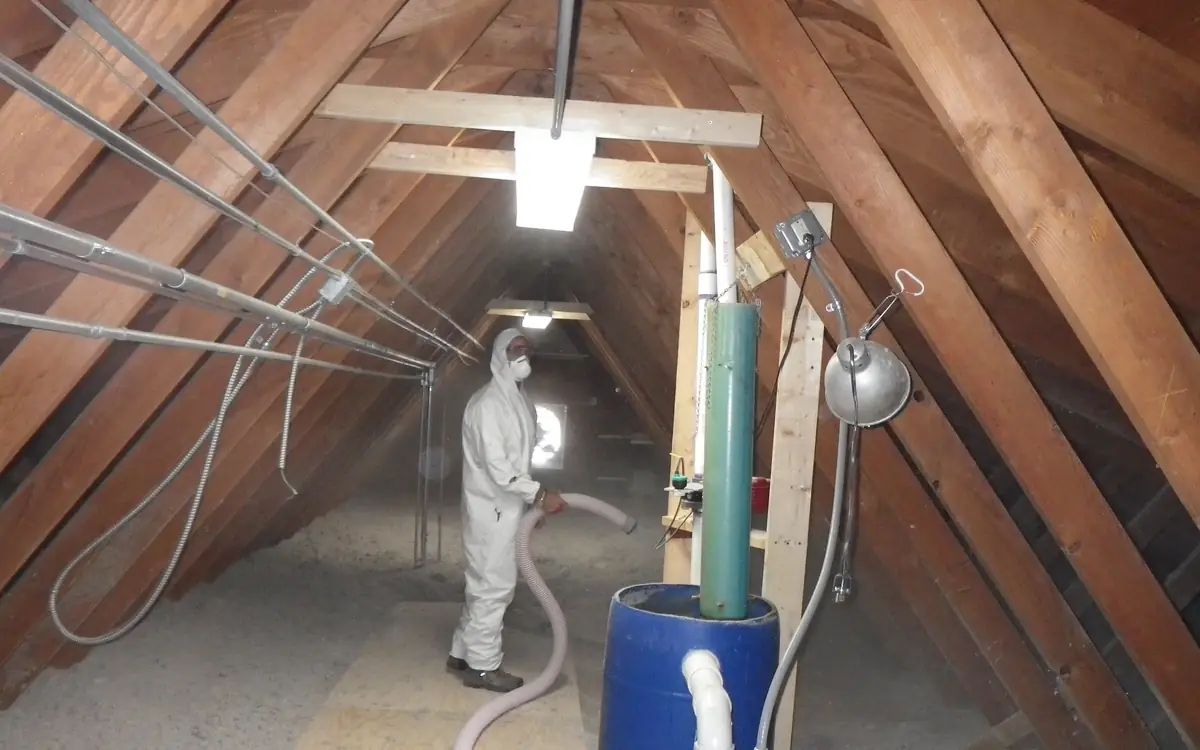
- Both, at different openings, and the choice follows the size of the hole. Foam is the material for the larger and more irregular bypasses — the gap around a plumbing stack, a chimney chase, a wiring penetration, a dropped soffit — because it fills a shape nobody can measure. Sealant handles the narrow continuous joints, most importantly the line where a partition top plate meets the ceiling, which is a long thin gap running through the whole house and one of the largest leakage paths in it. Two cautions specific to attics: nothing combustible goes against a chimney or a flue, where the code-required clearance is maintained with sheet metal and a high-temperature sealant; and recessed light fittings are sealed only in ways their own listing permits, since burying a fitting that is not rated for it is a fire risk.
- Can foam be used to insulate as well as seal?
- It insulates where it is, and treating it as an insulation strategy rather than an air-sealing one is a mistake of scale. A bead of foam around a penetration has an insulating value, but the area involved is tiny and the benefit comes overwhelmingly from stopping air movement rather than from the material's conductivity. Spray polyurethane foam installed as insulation is a different product and a different operation — applied over whole surfaces at specified thicknesses, with fire protection requirements over it and, for closed-cell products, a vapour-retarding effect that has to suit the assembly and the climate. The distinction matters because a can of gap filler and a professionally installed insulating foam share a chemistry and almost nothing else, including their fire performance and the rules governing where they may be left exposed.