
SettingsSettings for this calculationUS
The room's internal length, wall face to wall face.
The page treats the room as a box: length times width is the floor and the ceiling, and the perimeter times the height is the walls. For an L-shaped room, work the volume and surface areas out separately and use the walls box to make up the difference in wall area.
Tools needed: Laser measure or tape
The room's internal width, measured square to the length.
Measure at floor level, inside any skirting or wall lining. Where the walls are not parallel, use the average of the two ends.
Floor to ceiling, or to the face of a suspended ceiling where there is one.
Under a suspended ceiling, the room the sound lives in stops at the tiles, so measure to them; the void above counts only through the tiles' own coefficient, which a maker measures with the void behind it. A pitched ceiling can be entered at its average height.
The share of sound energy the floor finish absorbs at the band you are working in; 0.04 is lino or parquet on concrete at 500 Hz.
From Approved Document E's Table 7.1 at 500 Hz: hard floor coverings such as lino or parquet on a concrete floor 0.04, carpet on concrete 0.06, fair-faced concrete 0.01. Carpet climbs steeply with frequency, to 0.30 at 2000 Hz, which is why it does more for clatter than for low voices. Use the same octave band for every coefficient on the page.
The ceiling's coefficient at the same band; 0.10 is a suspended plasterboard ceiling with a large air space behind it, at 500 Hz.
Approved Document E's Table 7.1 gives a suspended plaster or plasterboard ceiling with a large air space 0.15 at 250 Hz, 0.10 at 500 Hz and 0.05 above that; a plastered concrete soffit is 0.01. For an acoustic tile ceiling over the whole room, enter the maker's practical coefficient for the band and the suspension depth fitted.
The coefficient of the wall finish, not counting windows and doors; 0.06 is painted concrete block at 500 Hz.
Approved Document E's Table 7.1 at 500 Hz: painted concrete block 0.06, fair-faced brick 0.03, fair-faced concrete or plastered masonry 0.01. Painting a porous block seals its surface and lowers its absorption, which is why the painted figure is the one usually wanted. The windows and doors below are taken off the wall area before this coefficient is applied.
The glazed area in the walls, taken off the wall area and given its own coefficient.
Add up the glass, frames included. A glazed screen or a fully glazed wall goes here too; glass is one of the most reflective surfaces in a room at middle and high frequencies.
0.05 at 500 Hz for windows and glass façades in Approved Document E's Table 7.1.
The same table gives 0.08 at 250 Hz, falling to 0.02 at 4000 Hz: large panes flex a little at low frequencies and so absorb a little there.
The area of the doors in the walls, taken off the wall area and given their own coefficient.
Width times height of each door leaf, added up. A single classroom door is about 2 m² (21.5 sq ft); a 3 by 7 ft leaf is 21 sq ft (1.95 m²).
0.08 at 500 Hz for timber doors in Approved Document E's Table 7.1.
The table gives timber doors 0.10 at 250 Hz and 0.08 from 500 Hz up.
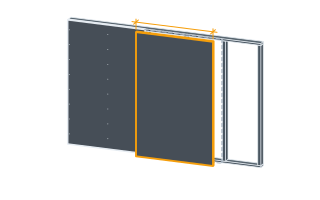
Acoustic panels or tiles fitted over part of the ceiling or walls; zero for none.
The absorber is counted in place of the surface it covers, chosen below: 10 m² (108 sq ft) of panels on the ceiling replaces 10 m² of the ceiling's own absorption with the panels'. Free-hanging clouds and baffles absorb on more than one face and are outside this simple model; use the maker's figure for one unit if they give it.
The maker's practical absorption coefficient at the same band; 1.00 is Rockfon Sonar 20 mm (0.79 in) thick on a 200 mm (7.9 in) suspension at 500 Hz.
Makers publish practical coefficients by octave band, measured to ISO 354 and rated to ISO 11654, for a stated mounting: the same tile on a shallower suspension absorbs less at low frequencies. Rockfon's published figures for Sonar, 20 mm (0.79 in) tiles on a 200 mm (7.9 in) suspension, run from 0.55 at 125 Hz to 1.00 at 4000 Hz. Use the single-band figure, not the weighted αw or an NRC, which average several bands.
Which surface the panels or tiles cover; the covered area stops counting at that surface's own coefficient.
Absorption on the ceiling and absorption on the walls count the same in Sabine's formula, which assumes sound reaches every surface evenly. In a room much longer than it is high, or a tall narrow stair, where absorption goes matters as well as how much, and the formula cannot show it.
The time your brief or standard asks for; the page opens on 0.8 s, a new secondary classroom under the UK's BB93.
BB93's Table 6 (2015) sets maximum mid-frequency times for schools in England, among them 0.6 s for a new primary classroom, 0.8 s for a new secondary classroom and 1.0 s for an office or staff room. Those are averages of the 500, 1000 and 2000 Hz bands, so to check one, work the page at each band and average the three times. US classrooms have their own figures in ANSI/ASA S12.60, and a recording studio or a hall is designed to a brief. The target only sets the absorption to add; the time itself does not depend on it.
Reverberation time
1.94 s
Sabine's formula: the room's volume times a constant, divided by its total absorption, gives the seconds a sound takes to die away by 60 decibels; the constant is 0.161 with the volume in cubic metres and the absorption in square metres, and 0.049 with cubic feet and square feet. It is worked at the one octave band the coefficients entered describe, for a room whose absorption is spread fairly evenly. The time worked out is longer than the target entered, by the absorption shown below; how and where to add it is a design decision for the room's acoustician or designer, and the figure here is for one band only.
- Room volume
- 5,382 ft³
- Room surface area
- 2,078 ft²
- Total sound absorption, A
- 136.2 ft²
- Average absorption coefficient
- 0.07
- Absorption to add for the target time
- 193.94 ft²
- Absorber area for that, at its coefficient
- 215.49 ft²
They open the calculator with your figures already in it
Reverberation Time Calculator (Sabine RT60): 1.94 s — shown in imperial, US market. The link sets both, so the result they see is the one on your screen.
Show calculation logicHide calculation logic
How this was calculated
Formula source(s)
- Steven Errede, University of Illinois at Urbana-Champaign, Physics 406 Acoustical Physics of Music, lecture notes 'Auditorium & Room Acoustics' (2017): Sabine's equation T = K V / A with K = 0.049 s/ft (= 0.161 s/m), A the room's absorption in square feet (square metres) of open window; worked example after Backus, 240,000 ft³ with 4,300 absorption units giving 2.7 s, and 7,800 units for 1.5 s
- HM Government, Approved Document E: Resistance to the passage of sound (2003 edition incorporating 2004, 2010, 2013 and 2015 amendments), Section 7: absorption area A = surface area x absorption coefficient, summed over the surfaces (7.14–7.16); Table 7.1, absorption coefficients of nine common materials at 250, 500, 1000, 2000 and 4000 Hz; Table 7.2, a worked entrance hall of 3.0 x 4.0 x 2.5 m; Method B's 0.20 m² of absorption per m³ for an entrance hall and 0.25 m² per m³ for a corridor (7.17, 7.18)
- Department for Education, Building Bulletin 93: Acoustic design of schools, performance standards (February 2015), section 1.5 and Table 6: mid-frequency reverberation time Tmf, the average of the 500 Hz, 1 kHz and 2 kHz octave bands, for rooms finished and furnished but unoccupied; a secondary classroom built new at 0.8 s or less, a primary classroom at 0.6 s or less
- Rockfon, Rockfon Sonar product data: practical sound absorption coefficients αp by octave band, measured to ISO 354 and rated to ISO 11654; 20 mm, A24 edge, 200 mm suspension: 0.55, 0.95, 1.00, 0.90, 1.00, 1.00 at 125 Hz to 4 kHz
Inputs used
- Room Length
- 26 ft
- Room Width
- 23 ft
- Ceiling Height
- 9 ft
- Floor Absorption Coefficient
- 0.04
- Ceiling Absorption Coefficient
- 0.1
- Wall Absorption Coefficient
- 0.06
- Window and Glazing Area
- 86 sq ft
- Window Absorption Coefficient
- 0.05
- Door Area
- 21 sq ft
- Door Absorption Coefficient
- 0.08
- Added Absorber Area
- 0 sq ft
- Absorber's Coefficient
- 1
- Absorber Fitted On
- The ceiling (it replaces that much ceiling)
- Target Reverberation Time (seconds)
- 0.8
Intermediate steps
- Room volume
- 5,382 ft³
- Room surface area
- 2,078 ft²
- Total sound absorption, A
- 136.2 ft²
- Average absorption coefficient
- 0.07
- Absorption to add for the target time
- 193.94 ft²
- Absorber area for that, at its coefficient
- 215.49 ft²
Confidence note: Sabine's formula: the room's volume times a constant, divided by its total absorption, gives the seconds a sound takes to die away by 60 decibels; the constant is 0.161 with the volume in cubic metres and the absorption in square metres, and 0.049 with cubic feet and square feet. It is worked at the one octave band the coefficients entered describe, for a room whose absorption is spread fairly evenly. The time worked out is longer than the target entered, by the absorption shown below; how and where to add it is a design decision for the room's acoustician or designer, and the figure here is for one band only.
What this calculation does not cover
- Sabine's formula assumes sound spreads evenly through the room and that absorption is modest and spread over the surfaces. In a very absorbent room, with an average coefficient of more than about a fifth, it overstates the time; in a room much longer than it is wide or high, or with all the absorption on one surface, the measured decay can differ a good deal from it.
- One octave band. Every coefficient changes with frequency, so a room can be right at 1000 Hz and boom at 125 Hz; work the page band by band with each surface's coefficient for that band, as Approved Document E's Table 7.1 and makers' data give them.
- Furniture, people and air are not counted. Seats, desks, bookshelves and occupants all absorb, and air absorbs noticeably at high frequencies in a large room; school standards such as BB93 state their times for a room finished and furnished but unoccupied.
- It says nothing about sound insulation. Reverberation is how long sound lingers inside a room; how much gets through its walls and floors is a different property, measured and specified separately, and the page's related sound-insulation calculators cover it.
- No standard is checked. The target is the figure entered, and a reverberation time from this formula is a design estimate; whether a finished room meets a specification is settled by measuring it to the method that specification names.
Add the equipment this sizes
This result is a specification — 1.94 s — not a quantity. Put the thing it sizes into your project: how many, what you call it, and your supplier’s price.
Computed in your browser — nothing you enter is uploaded. Presented in US customary units and US trade terminology. Where a formula follows a published standard, that standard and its edition are cited beside it on this page; where none governs, the page says so. Local amendments override model codes — verify against the code in force where you build.
Sources checked 2026-10-05 · v1.0.0
Regulatory standards & verification citations4
- Steven Errede, University of Illinois at Urbana-Champaign, Physics 406 Acoustical Physics of Music, lecture notes 'Auditorium & Room Acoustics' (2017): Sabine's equation T = K V / A with K = 0.049 s/ft (= 0.161 s/m), A the room's absorption in square feet (square metres) of open window; worked example after Backus, 240,000 ft³ with 4,300 absorption units giving 2.7 s, and 7,800 units for 1.5 s
- HM Government, Approved Document E: Resistance to the passage of sound (2003 edition incorporating 2004, 2010, 2013 and 2015 amendments), Section 7: absorption area A = surface area x absorption coefficient, summed over the surfaces (7.14–7.16); Table 7.1, absorption coefficients of nine common materials at 250, 500, 1000, 2000 and 4000 Hz; Table 7.2, a worked entrance hall of 3.0 x 4.0 x 2.5 m; Method B's 0.20 m² of absorption per m³ for an entrance hall and 0.25 m² per m³ for a corridor (7.17, 7.18)
- Department for Education, Building Bulletin 93: Acoustic design of schools, performance standards (February 2015), section 1.5 and Table 6: mid-frequency reverberation time Tmf, the average of the 500 Hz, 1 kHz and 2 kHz octave bands, for rooms finished and furnished but unoccupied; a secondary classroom built new at 0.8 s or less, a primary classroom at 0.6 s or less
- Rockfon, Rockfon Sonar product data: practical sound absorption coefficients αp by octave band, measured to ISO 354 and rated to ISO 11654; 20 mm, A24 edge, 200 mm suspension: 0.55, 0.95, 1.00, 0.90, 1.00, 1.00 at 125 Hz to 4 kHz
Which documents these citations point at
- Approved Documents to the Building Regulations (England) — E (United Kingdom)Practical guidance on meeting the Building Regulations, one lettered part per subject — Part A structure, Part B fire, Part K protection from falling, Part L conservation of fuel and power, and the rest.
Standards referenced: ISO 11654 (International Organization for Standardization, International).
A code or standard has force only where a jurisdiction has adopted it, usually with local amendments. This site holds no adoption data for any authority, so check what is in force with the authority where you build. Any section cited above without an edition should be checked against the edition in force where you build. What it would take to know.
Cite this page
Your workspace
Most jobs need more than one number. Add the calculators you need next and they open right here, underneath this one — your figures stay on screen and nothing is lost to a page change.